
Regulatory Label Changes: From Months to One Edit
PPWR recently became enforceable across the EU and despite most teams knowing it was coming, plenty still weren't ready. For the most part, this was not because they had misread the regulation, but rather because they just couldn't move fast enough once they knew what it meant.
Regulations affecting packaging are being introduced and updated all the time with sustainability and patient safety (quite rightly) becoming increasingly scrutinized. We’ve mapped out some of the biggest and most pressing ones in our latest free resource, but it takes a lot more than being aware of the regulation to be prepared for the regulation – especially when it could change again at any moment!
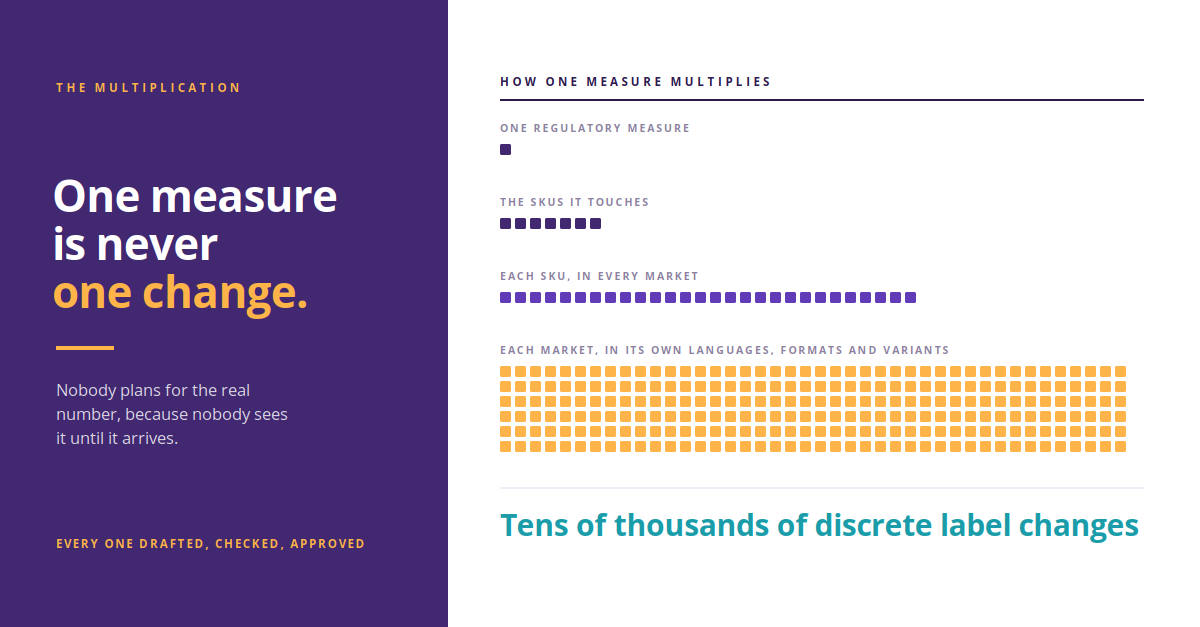
And if that’s not enough to have your regulatory affairs team stressed out, then do the multiplication and realize that each measure touches a set of SKUs and each SKU appears in several markets and each market wants its own languages, its own pack formats, its own regional variants. Seventeen regulations suddenly become tens of thousands of discrete label changes, all of which needs drafting, checking, approving and evidencing. Unfortunately, we often find that nobody plans for that number because nobody sees it until it arrives.
Why Packaging Updates Are Simpler Than You Probably Think
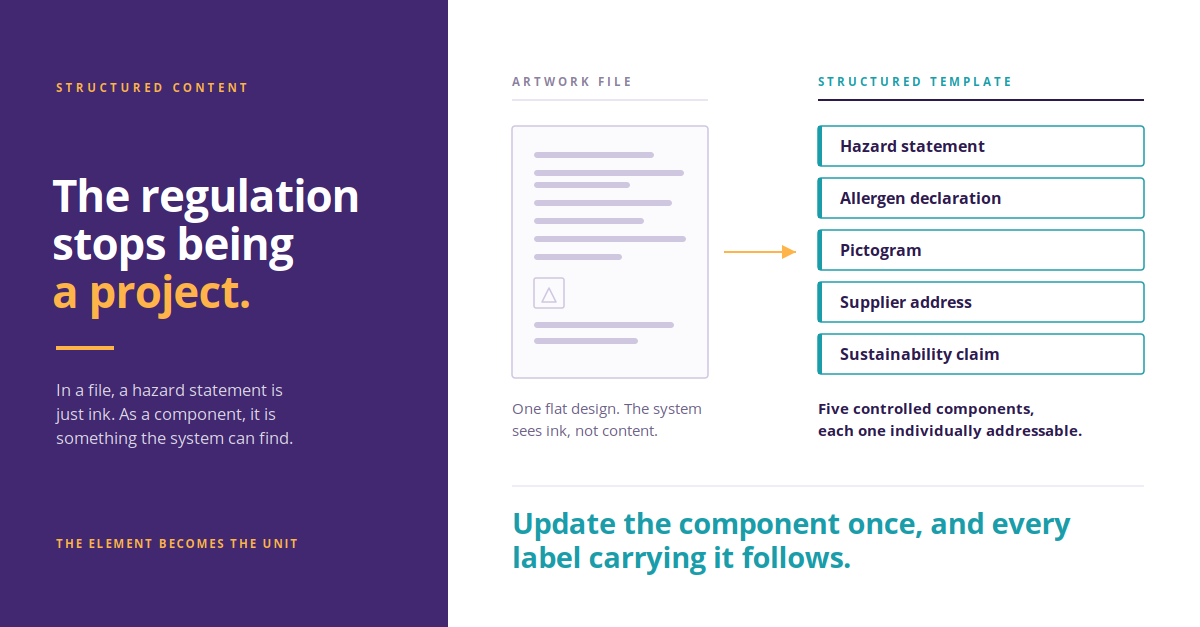
If you strip away the legal text, the reality of a regulation update is that a controlled element on your label has changed. Whether it’s a hazard statement, an allergen declaration, a supplier address, a sustainability claim, the work underneath is the same. This therefore raises the question: if the work is the same every time, why does every regulation land like a brand new crisis for so many businesses?
Your Process is Holding You Back
Most organizations still hold their labels as artwork files. Unfortunately, in that world, a hazard statement is not something your system knows about or can easily locate and update for you. So when the statement changes, you can't update the statement. You can only open files and go looking for it.
Which is why the first few weeks (or even months) of every regulatory project are spent on a question that has nothing to do with regulation: which of our labels does this actually affect? Somebody builds a spreadsheet while somebody else cross-references it against the product master and then a third person finds four SKUs that were missed, usually late, usually in a market nobody thought about. And then this all gets repeated in full, from scratch, every single time. Sound familiar?
What Changes When the Element is the Unit
Now imagine the same seventeen measures landing on a library where every phrase, symbol, pictogram, warning and image is stored as its own approved, reusable asset, and templates assemble those assets into finished labels. You already know where every element is used, because the relationship is data rather than memory.
Update the hazard statement once, with one simple click, and it flows to every label that carries it, in every language, with the version history sitting behind it. The regulation stops being a project and instead becomes a simple edit. That is the difference between a team that spends 2027 reacting and a team that spends it prepared. Which would you prefer?
Where Kallik Comes In
Veraciti™ was built for regulated manufacturers from the start rather than adapted for them later, and it shows in the parts that usually hurt most.
Where Used answers the scoping question instantly, so the two weeks of archaeology never happen. Cloud Designer lets your own people build and amend labels without specialist desktop software or a third-party studio on retainer. And the approval workflows were designed around genuinely regulated sign-off, with the audit trail produced as a byproduct of the work rather than reconstructed afterward for an inspector.
The objection we most often hear when it comes to switching from emails and spreadsheets to a fully end-to-end software like ours is: migration. Twenty years of accumulated artwork files, and the reasonable fear that moving them will be long, complicated and painful. That is exactly why we built AToM, an AI-driven tool which digitizes existing labels into structured, reusable components automatically and accurately.
We help our customers to reach full regulatory compliance and hold it there. The days of headaches and stress from regulatory updates are gone, and instead of hiring a team to help you manage the changes, you can simply make thousands of changes with the click of a button.
See the Full Picture and Stay Ahead
We've put some of the biggest and most important regulation updates in a single infographic, grouped by industry, mapped by market and sequenced by deadline. It's free, it's detailed, and it's the clearest view we've found of what the next few years actually look like.
Interested in learning more? Why not book in for a free, no-obligation chat with one of our label and artwork management experts by calling +44 (0) 1827 318100, emailing enquiries@kallik.com, or filling in a form here. Alternatively, learn more about how Kallik works here.
FAQs about regulatory label changes
Why do regulatory label changes take so long?
Most of the time goes on scoping rather than on the change itself. When labels are held as artwork files, a hazard statement or allergen declaration exists only as ink inside a PDF, so the system cannot tell you which labels contain it. Teams build spreadsheets, cross-reference them against the product master, and still miss SKUs in markets nobody thought about — and the whole exercise is repeated from scratch for every new regulation.
What is structured content in label management?
Structured content means storing every phrase, symbol, pictogram, warning, and image as its own approved, reusable asset, with templates assembling those assets into finished labels. The label becomes a set of relationships between controlled elements rather than a flat design file. That is what allows a change to one element to flow through to every label that carries it, in every language, with the version history behind it.
How do you find every label affected by a regulation change?
If labels are stored as structured content, the system already knows where every element is used, because the relationship is recorded as data rather than held in someone's memory. A query returns every artwork containing a given phrase or symbol in seconds. In Kallik's Veraciti™, the Where Used feature does this and pulls the affected labels into a single project, so they can be updated together and approved in one sign-off rather than opened one at a time.
What is the difference between an artwork file and a label template?
An artwork file is a finished design, and the regulatory content inside it is not separately identifiable to the system. A label template is a structure that assembles approved, individually controlled components into a finished label. The practical difference shows up when something changes: an artwork file has to be found and edited by hand, while a template updates automatically when the component it references is updated.
What happens to existing artwork when moving to a structured labeling system?
Existing artwork does not have to be rebuilt by hand. Kallik's AToM is an AI-driven migration tool that reads existing labels and artwork, breaks them down into their areas of content, and builds structured, reusable templates automatically. It identifies and removes duplicate phrases and symbols along the way, so the result is a deduplicated library rather than a copy of the original file store.