
What Is Label Artwork Management Software? A Buyer's Guide
One out-of-date hazard symbol can hold a shipment at customs. One mismatched ingredient statement can trigger a recall across three continents. For organizations managing thousands of SKUs across dozens of markets, label and artwork accuracy is a major business risk.
Most companies only start shopping for label artwork management software once that risk becomes visible. This guide explains what the software actually does, which features matter, and how to compare vendors before you commit.
What is label artwork management software?
Label artwork management software is a centralized platform that manages the full lifecycle of product labels and packaging artwork – content creation, translation, review, approval, version control, and print-ready output – in one controlled system. It replaces the spreadsheets, shared drives, email approval chains, and disconnected design tools that most organizations begin with, giving every team a single source of truth for label content and artwork.
The strongest platforms combine two capabilities that are often sold separately: artwork management (design, proofing, approval workflows) and labeling management (structured content, phrases, symbols, regulatory data). Keeping them in one system is what removes the copy-paste errors that cause compliance failures.
Who needs it?
Label artwork management software is built for regulated and high-complexity industries, including:
- Pharmaceuticals and life sciences
- Medical devices and IVD
- Chemicals, oil, and lubricants
- Cosmetics and personal care
- Food, beverage, and consumer goods
If your business faces multi-market regulatory change, frequent artwork revisions, or audits that require a defensible history of every label version, manual processes will eventually become the bottleneck.
Core features to look for
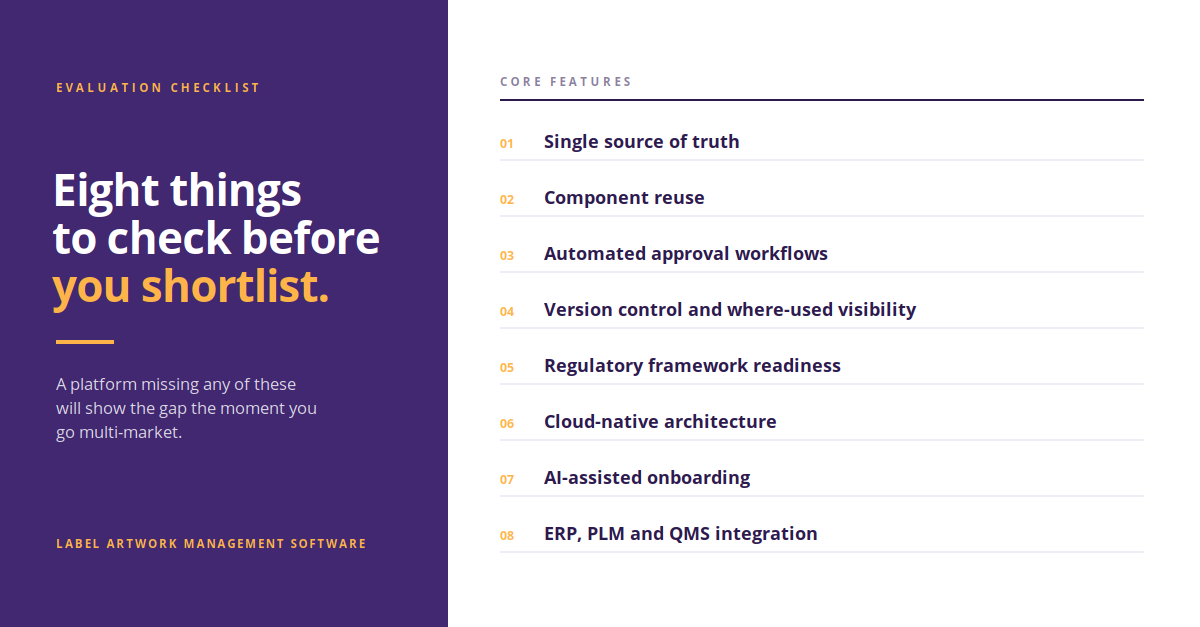
Use this as your evaluation checklist:
Single source of truth: one governed repository for all label content, artwork, images, and symbols.
Component reuse: approved phrases, warnings, and symbols reused across SKUs instead of recreated each time.
Automated approval workflows: routed reviews with electronic signatures and full audit trails.
Version control and "where used" visibility: instantly see every product affected by a single content change.
Regulatory readiness: support for frameworks such as EU MDR, 21 CFR Part 211, CLP, and Digital Product Passports.
Cloud-native architecture: global access, faster deployment, and no infrastructure burden.
AI-assisted onboarding: automated migration of legacy labels so implementation is measured in weeks, not years.
Integration: connections to ERP, PLM, and QMS so label data stays synchronized with product data.
Label artwork management vs. label printing software
These categories are frequently confused, and the difference matters when you build your shortlist.
| Criteria | Label printing software | Label artwork management software |
|---|---|---|
| Primary purpose | Design and print barcodes and labels | Govern the entire label and artwork lifecycle |
| Approval workflows | Minimal or manual | Automated, audited, signature-controlled |
| Best fit | Small to mid-sized, print-focused operations | Global, regulated, multi-SKU enterprises |
| Compliance evidence | Limited | Full audit trail and version history |
If your requirement is simply printing labels on the production line, printing software may be enough. If you need to prove why a label says what it says, you need artwork management.
Five questions to ask every vendor
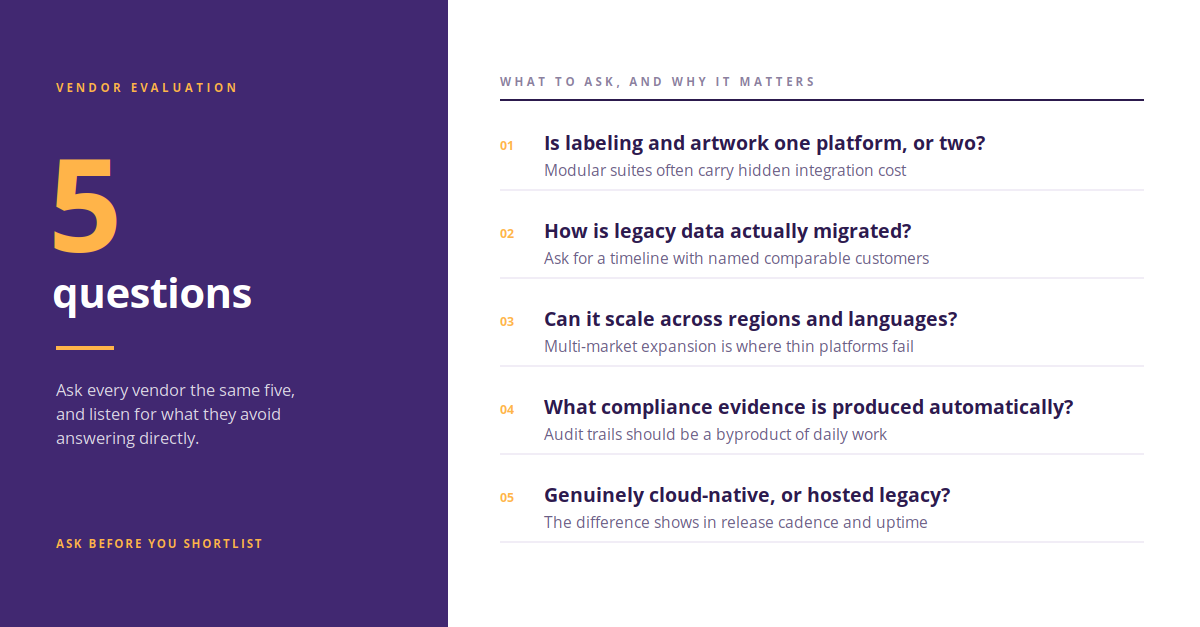
- Is labeling and artwork one platform or two integrated products? Modular suites often carry hidden integration cost.
- How long does implementation take, and how is legacy data migrated? Ask for a realistic onboarding timeline with named comparable customers.
- Can it scale across regions and languages? Multi-market expansion is where thin platforms fail.
- What compliance evidence does it produce automatically? Audit trails should be a byproduct of daily work, not a manual exercise.
- Is it genuinely cloud-native, or a hosted legacy system? The difference shows up in release cadence and uptime.
To see how leading platforms stack up on these criteria, compare Kallik vs. Loftware, Kallik vs. Esko, and Kallik vs. BarTender.
The bottom line
Label artwork management software pays for itself in avoided rework, faster time to market, and audit confidence. The right choice depends on your scale and regulatory exposure: smaller, print-led operations may be well served by lighter tools, while global regulated enterprises need a unified platform built for complexity.
Kallik's Veraciti™ brings labeling and artwork together in one cloud-native platform designed for regulated industries. Book a demo to see it applied to your portfolio.
FAQs on label artwork management software
What is label artwork management software?
Label artwork management software is a centralized platform that controls the full lifecycle of product labels and packaging artwork, including content creation, translation, review, approval, version control, and print-ready output. It gives regulated organizations a single source of truth and an audit trail for every label change.
What is the difference between artwork management and labeling management?
Artwork management covers the visual design, proofing, and approval of packaging and label artwork. Labeling management covers the structured content within a label, such as approved phrases, warnings, symbols, and regulatory data. Unified platforms handle both, which removes the manual transfer errors that occur when the two are managed separately.
Which industries use label artwork management software?
It is used most heavily in regulated sectors: pharmaceuticals, medical devices, chemicals, cosmetics, food and beverage, and consumer goods. These industries face frequent regulatory change, multi-market labeling requirements, and audits that demand a documented history of every label version.
How long does it take to implement label artwork management software?
Timelines vary with portfolio size and data quality. Legacy on-premise projects historically ran for a year or more, while cloud-native platforms with AI-assisted label migration can shorten onboarding significantly. Ask each vendor for a phased plan and reference customers of similar complexity.
Do I need label artwork management software if I already have label printing software?
Often, yes. Printing software creates and outputs labels but typically lacks controlled approval workflows, version history, and compliance evidence. If you must demonstrate to a regulator how a label was approved and by whom, printing software alone will not cover it.