
Medical Device Regulations to Watch in 2026
Why the next wave of regulatory change will put labeling and packaging under pressure.
Most medical device companies aren’t prepared for 2026 and they don’t realize it yet. Your labeling process could already be out of date, but you just haven’t been forced to prove it yet. As new regulations roll out across 2026, the gap between compliant systems and manual workflows is becoming harder to ignore.
For years, regulatory change followed a familiar pattern. A new rule would emerge, teams would mobilize, deadlines would loom, and eventually things would settle again. However, that model no longer applies as regulatory change is becoming continuous, overlapping, and increasingly data-driven.
In this blog, we break down the key medical device regulations to watch in 2026, what they mean for your labeling operations, and why preparation will define success.
The Shift: From Regulatory Deadlines to Continuous Change
It's all about convergence now – multiple global initiatives, each with their own requirements, all landing at the same time. Together, they are reshaping how labeling works. Labels are now structured, data-linked, and expected to stay synchronized with regulatory systems in near real time. That creates a new operational reality and if your processes rely on manual updates, disconnected systems, or periodic reviews, the risk isn’t just inefficiency, it’s non-compliance.
Key Medical Device Regulations to Watch in 2026
Here are the major regulatory drivers that will directly impact labeling and packaging over the next 12–24 months.
EU MDR and IVDR (and EUDAMED rollout)
While MDR and IVDR are already in effect, 2026 marks a critical milestone with the full activation of EUDAMED modules. This introduces a new expectation: your physical label must match your digital regulatory data exactly. Every claim, warning, and identifier must align with what is submitted to the database.
For labeling teams, this means:
- Labels must act as a “digital twin” of regulatory submissions
- Any mismatch between artwork and EUDAMED data can trigger compliance issues
- Labeling must integrate more tightly with regulatory and product data systems
- This is a shift from document management to data synchronization.
UDI (Unique Device Identification) Expansion
UDI is now a global requirement, expanding across regions including the EU, US, China, and beyond. By 2026, even legacy devices in the EU must be fully registered. The impact on packaging is immediate:
- More identifiers and barcodes on every label
- Increased risk of clutter and layout constraints
- Greater need for consistency across systems
The UDI on the label must match what exists in regulatory databases, manufacturing systems, and supply chain records. Managing this manually at scale introduces significant risk.
eIFUs (Electronic Instructions for Use)
The move toward digital instructions continues to accelerate, particularly under EU 2021/2226 updates. This reduces paper but adds complexity:
- Labels must include persistent URLs or QR codes
- The linked IFU must always be the correct, approved version
- Version control becomes critical across languages and markets
For packaging teams, this introduces a new dependency: your label is now directly connected to live digital content. Any disconnect creates compliance exposure.
EU AI Act
The EU AI Act introduces new requirements for AI-enabled medical devices, with major implications for labeling. For high-risk systems:
- Labels and IFUs must clearly disclose the use of AI
- Detailed information about performance, limitations, and training data is required
- The AI version must align exactly with labeling and declarations
This creates a new challenge as software evolves quickly, but labeling processes typically do not. Keeping both in sync requires a more agile, data-driven approach.
GS1 Sunrise 2027
Although the deadline is 2027, 2026 is the year organizations need to act. GS1 Sunrise mandates the shift from traditional barcodes to 2D DataMatrix or QR codes. These codes carry significantly more data and can link to digital resources. For labeling and packaging:
- Artwork must be redesigned to accommodate 2D codes
- Legacy barcodes must be replaced across entire portfolios
- Labels must support richer, connected data
The scale of change is the real challenge here as thousands of SKUs require updating – often simultaneously.
PPWR (Packaging and Packaging Waste Regulation)
Sustainability is now regulated, not optional. The EU’s PPWR introduces:
- Standardized recycling labels and material identifiers
- New pictograms on packaging
- Increased pressure on label space and design
This adds another layer of mandatory content to already crowded labels, forcing teams to rethink layout, hierarchy, and clarity.
EU Battery Regulation
For devices containing batteries, new requirements introduce the concept of a “Battery Passport.” This includes:
- QR codes linking to sustainability and lifecycle data
- New labeling requirements for carbon footprint and recycling
- Additional coordination between product and packaging data
This is where regulatory overlap becomes visible. Battery labeling must align with MDR/IVDR requirements, often within the same constrained space.
Why This Matters: The Growing Risk of Manual Processes
Individually, each of these regulations is manageable. However, together, they create a level of complexity that manual processes cannot sustain as every new requirement adds more data points, more variations across markets, and more synchronization between systems. Consequently, if your process relies on spreadsheets, disconnected tools, or manual artwork updates, the risk compounds quickly.
This is why labeling continues to be a leading cause of recalls – because teams lack expertise, but because the system they operate in cannot scale with the volume of change.
The Real Priority for 2026: Readiness, Not Reaction
The organizations that will succeed in this environment aren’t the ones reacting fastest to each regulation, but the ones that have built systems capable of absorbing change continuously.
That means centralizing labeling data into a single source of truth, automating artwork generation and updates, and ensuring full traceability across products and markets. In other words, it means moving from compliance firefighting to operational readiness.
A Practical Guide to Getting Prepared
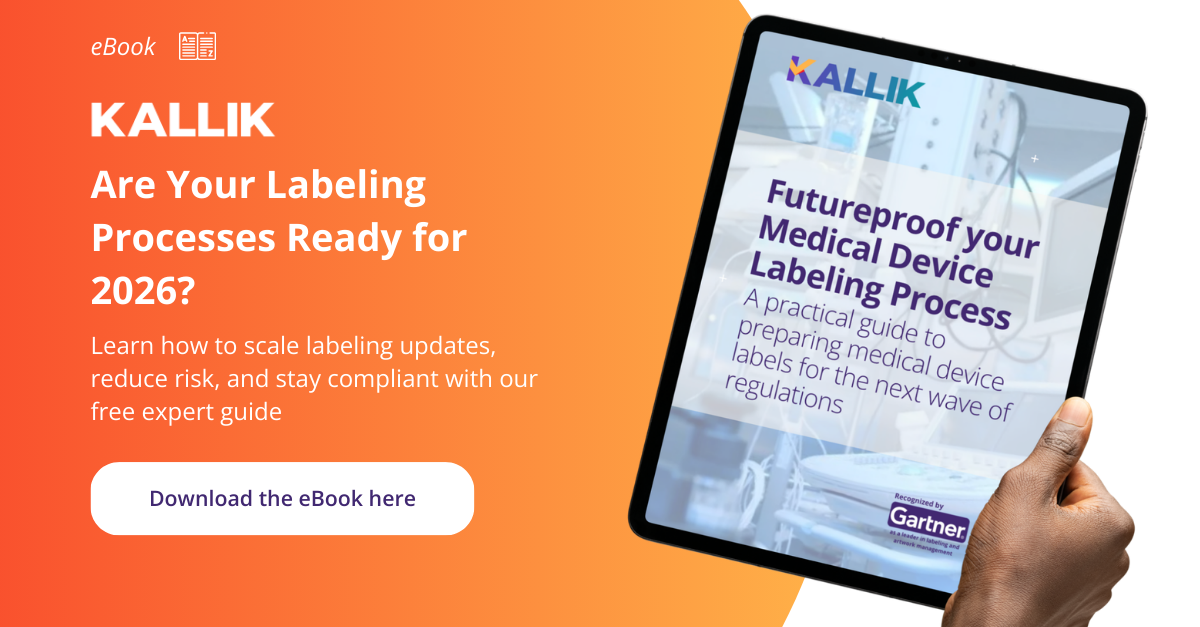
To help medical device teams navigate this shift, we’ve created a new guide: “Get Proactive and Futureproof your Medical Device Labeling Process”. It breaks down:
- What these regulatory changes mean in practice
- Why manual processes are becoming a liability
- How to build a scalable, future-ready labeling operation
If you’re responsible for regulatory, labeling, quality, or packaging, this guide will give you a clear roadmap for what comes next because regulatory change isn't going to slow down. Now is the time to assess where your risks are and how prepared your organization really is. Download the free guide below to understand what’s coming and how to stay ahead of it.
Subscribe to our newsletter for all the latest label and artwork news