
“If Gartner had a Magic Quadrant for LAM, Kallik would be top right”
There is a dangerous misconception in labeling and artwork management: that the label is the thing you see at the end. Reality is… it is not.
The label is the visible output of thousands of invisible decisions. From product data and regulatory requirements, translations. change requests, and review cycles. Every one of those decisions has to be right, every time, in every market.
That is why Labeling and Artwork Management, or LAM as Gartner says, has become integral to compliance for regulated businesses.
Why LAM Has Become a Strategic Compliance Category
This is why this comment from John Blake, Gartner LAM Analyst, stood out so strongly in recent external investor research: “If Gartner had a Magic Quadrant for LAM, Kallik would be the leader in the Upper Right.” It is a bold statement but it also captures exactly where the LAM category is heading.
In the familiar Magic Quadrant model, the top right is where ability to execute meets completeness of vision. For LAM, that means a platform must do two things exceptionally well: solve the complex labeling challenges enterprises face today, while giving them the architecture to compete, comply and scale tomorrow.
What a Magic Quadrant for LAM Might Look Like
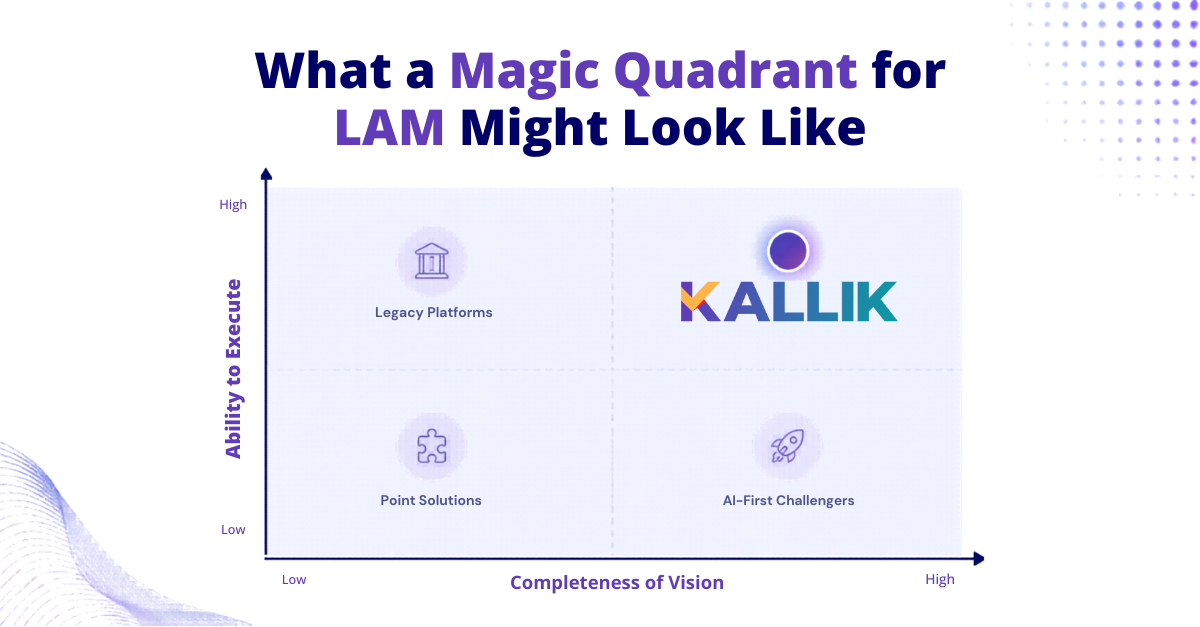
If a Magic Quadrant for LAM existed, the lower-left would be filled with tools that solve isolated problems: artwork creation, workflow routing, file storage or print handoff. Useful, yes! Strategic, no.
The top-left would include legacy platforms with enterprise footprint, but limited flexibility. They may execute established processes, but they struggle to adapt to a world of structured data, automation and AI. The lower-right would likely include newer AI-first challengers: fast, modern and exciting, but without the regulatory depth, trust and embedded workflows required in highly regulated industries.
The top-right would belong to something rarer: a platform that combines proven enterprise execution with a clear vision for the future of labeling. That is Kallik – and the first reason for this is composability. Most LAM platforms still treat labeling and artwork as documents or workflows. Kallik, on the other hand, treats content as data – and that distinction matters enormously!
Why Composability Matters
In a traditional environment, a regulatory phrase, product claim, symbol or company address may be buried inside thousands of different artwork files. If something changes, teams have to find every instance, update it, re-check it and re-approve it. That is slow, expensive and incredibly risky.
Kallik takes a different approach by breaking labeling and artwork content down into structured, reusable components. Phrases, translations, symbols, claims, addresses and market-specific content can be centrally controlled and reused across the label estate.
So when something changes, it can be updated once and flow through the right labels with far greater consistency and control. This is a game changer for highly regulated industries managing thousands of labels and artwork across the globe.
Composable LAM means regulated businesses can stop managing disconnected files and start managing governed content. It gives them the foundation for automation, intelligence and AI, because AI is only as good as the data it can understand. If the data is fragmented, AI simply accelerates the mess. However if the data is structured, AI becomes genuinely useful.
Why Artwork Assets Need Enterprise-Level Control
The second reason is asset management. In regulated industries, artwork is a controlled enterprise asset. Every version matters, every market variation matters, every approval matters, and every audit trail matters.
Kallik acts as the authoritative system of record for labeling and artwork assets. It gives global teams one place to manage SKU label versions, market-specific variants, approval histories, lifecycle governance, regulatory traceability and audit documentation. As a result, businesses achieve confidence at scale with Kallik.
For a pharmaceutical, medical device, chemical, cosmetics or consumer goods business, the question is not simply, “Can we produce the label?” The real question is, “Can we prove the label is correct, compliant, approved and current everywhere it is used?” Kallik is built to answer that question.
Why End-to-End Process Control Matters in LAM
The third reason is end-to-end process control. Labeling involves the collaboration between regulatory, quality, packaging, manufacturing, supply chain, legal, marketing and artwork teams. It also depends on data from enterprise systems such as ERP, PLM, PDM and RIM. When those processes are fragmented, it increases risk, affects visibility, and significantly slows everything down.
Kallik provides a cloud-native, single-instance platform covering the full LAM lifecycle, from content and label design through change management, approvals, compliance sign-off, production readiness and auditability. It becomes the central node connecting people, processes, systems and assets.
That is why it’s important to look for more than just a label and artwork tool – especially in a world where AI exists.
How AI Is Changing the Future of LAM
AI will change LAM, but not in the way some people think. In regulated labeling, outputs must be controlled, repeatable, validated and audit-ready. A generic AI tool can help draft content or accelerate tasks, but it cannot replace regulatory trust, system-of-record governance or years of embedded process knowledge.
Kallik’s position is different because AI strengthens the platform rather than threatens it. With structured component-level data, deep regulatory workflows and audit-ready governance already in place, Kallik has the foundation to move from system of record to system of intelligence. This is why the “top right” argument matters.
The future of LAM will not be won by whoever can create artwork fastest. It will be won by the platform that can control complexity, reduce risk, enable automation and prove every output is right. That’s where the real value lies.
Build the Foundation for Labeling and Artwork Confidence
Kallik brings together the things regulated enterprises need most: composability, asset control, end-to-end process governance, regulatory depth, AI readiness and deterministic compliance.
That is not just a strong position in the LAM market. It is what leadership looks like. And if Gartner had a Magic Quadrant for LAM, that is why Kallik would be top right.
If you're thinking about how to build that foundation in your labeling and artwork operations, Kallik’s label and artwork platform is designed to do exactly that. Get in touch to find out more by calling +44 (0) 1827 318100, emailing enquiries@kallik.com or filling in a form here.