
AI Won't Fix Bad Data: Why Regulated Industries Are Sitting on a Compliance Timebomb
There's a lot of noise right now about what AI can do for labelling and artwork management. Less is being said about what it can't do: turn messy, fragmented data into something trustworthy.
That's the warning Kallik is putting out to regulated industries this month. As the global leader in enterprise labelling and artwork management software, working with brands including Kenvue, Cardinal Health and Procter & Gamble, we're seeing a pattern that worries us: companies under pressure are adopting AI tools before they've sorted out the "operational basics." And in pharma, med device, and other highly regulated sectors, that gamble carries real consequences.
The squeeze that's driving the rush
It's not hard to see why teams are reaching for AI. Regulatory overhauls across the US and Europe are approaching fast, skills shortages are leaving already-stretched teams struggling to manage increasingly complex product lifecycles, and there's constant pressure to protect margins while getting products to market quickly.
Faced with all that, automation looks like the obvious answer. AI tools promise to handle intricate labelling updates, multi-language translations and shifting regulations at a pace manual, under-resourced teams simply can't match. The problem isn't the ambition. It's what happens when that ambition meets poor foundations.
Panic buying meets fragmented data
We're calling it panic buying for a reason: businesses are deploying AI checking mechanisms on top of siloed, inconsistent data, and that combination opens the door to serious compliance errors.
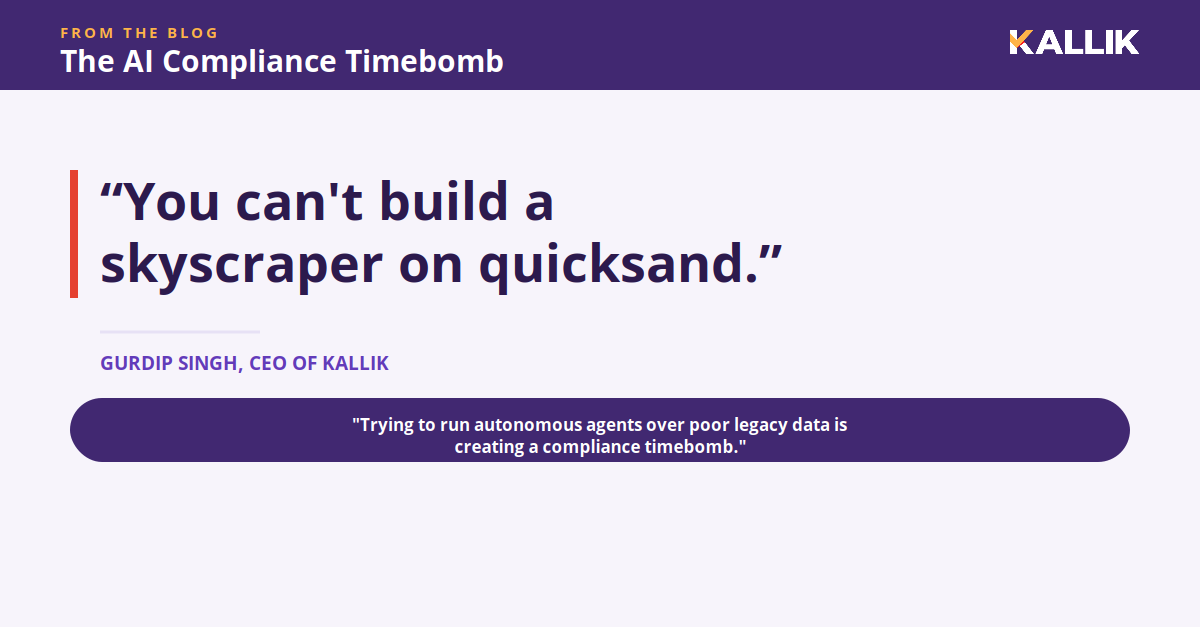
Gurdip Singh, CEO of Kallik, puts it bluntly: "There's a massive amount of noise in the market right now about what AI can do, but trying to run autonomous agents over poor legacy data is creating a compliance timebomb. One that pharma and med device manufacturers will absolutely want to avoid."
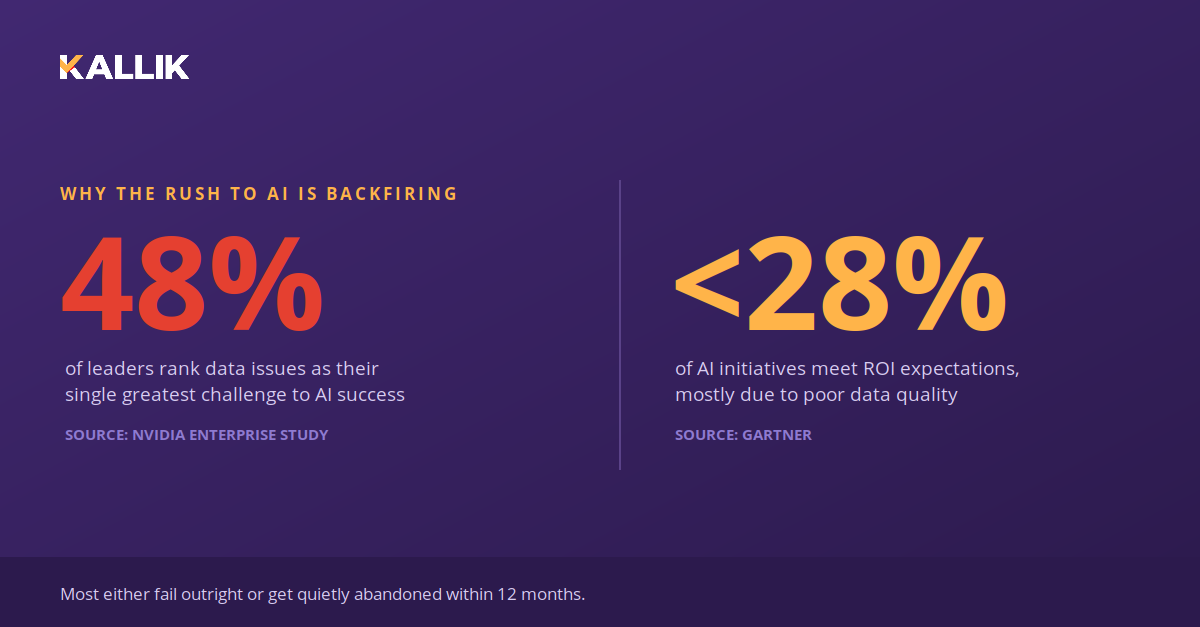
It's not an isolated concern either. A recent NVIDIA enterprise study found that 48 percent of leaders rank data-related issues as their single greatest challenge to successful AI implementation. As Gurdip puts it: "You can't build a skyscraper on quicksand."
What actually goes wrong
When an AI tool queries unchecked, fragmented data, it starts connecting the wrong dots. That might mean silently dropping a European date format into a US template, or subtly altering a mandatory font.
In a low-stakes environment, that's an annoyance. In pharma or med device labelling, it's a different story entirely. A tiny hallucination like that can break the entire chain, triggering compliance failures, reputational damage and multi-million-pound product recalls, each one putting patients at risk.
This isn't a fringe issue, either. A global Gartner study found that fewer than 28 percent of AI initiatives meet ROI expectations, largely because of poor data quality. Most either fail outright or get quietly abandoned within 12 months.
Fixing the foundation first
This is why Kallik built its approach around data before automation, not the other way round. Our innovative migration tool, AToM (Assisted Tool of Migration), is a pure AI-driven engine that intelligently reads and extracts data from legacy formats at the onboarding stage, eliminating the manual input errors and duplicates that feed AI hallucinations in the first place.
That clean, accurate data then feeds directly into Veraciti™, our cloud-native single source of truth. Veraciti™ atomises content into pre-approved, version-controlled building blocks within a central asset and phrase manager. Because the data layer is fully structured, Veraciti™ stays entirely vendor-agnostic, so enterprises can securely plug and play any corporate LLM or external AI tool into a validated environment via secure APIs.
"We still continue to see businesses storing their data in spreadsheets or on old, outdated software, either updated by several different people across various departments, or by no one at all," Gurdip says. "So if you don't know what 'language' your data speaks, or whether it's the very latest version of information, your AI certainly won't."
The stress test regulated industries can't afford to fail
Gurdip concludes: "This new wave of AI adoption in the industry feels like a new kind of stress test. Advanced automation can easily handle massive data migrations and instant multi-language updates at lightning speed, but it requires an absolute single source of truth to pull from. Without that ironclad data, you are effectively letting an autonomous system fly blind into a regulatory storm."
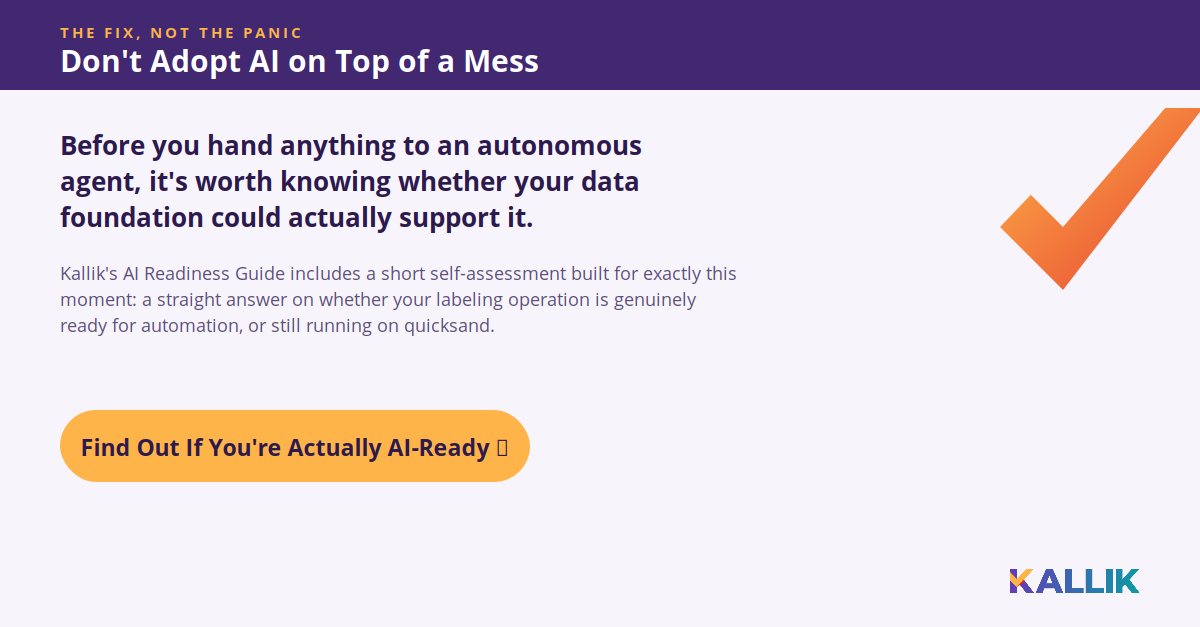
For regulated industries, the message isn't "don't adopt AI." It's "don't adopt it on top of a mess." Get the data foundation right, and automation becomes a genuine advantage rather than a hidden liability.
We've spent years inside exactly this problem with global, regulated manufacturers. If your team has ever quietly wondered whether "organized" and "audit-ready" are actually the same thing, this is worth twenty minutes of your time before you commit to an AI roadmap, not after.