
How EU Labeling and Packaging Regulations Are Changing in 2025
Three major regulatory updates are set to reshape compliance requirements this year, making it critical for businesses in the EU and/or manufacturing products for consumption in the EU to take action now in order to stay compliant. Here’s everything you need to know and how you can get ahead...
A Fresh Look at Plant Protection Product Labeling for Regulation 547/2011
Regulation 547/2011 was implemented back in 2011 to establish uniform rules on how essential information, including safety precautions, usage instructions, and environmental protection measures, should be presented on pesticide labels.
How the 547/2011 Regulation Update Affects Product Packaging and Labeling:
The European Commission has recently published a draft regulation aiming to amend the current labeling standards to enhance harmonization, improve risk communication, and ensure robust safety and sustainability measures.
The proposed changes aim to improve clarity, accessibility, and safety in pesticide labeling. Labels will feature color-coding to indicate hazard levels, digital labeling for better accessibility, and clear risk mitigation phrases for environmental and human health protection. Products under parallel trade permits will have specific labeling requirements, and a bee hazard pictogram will be introduced to highlight risks to pollinators. These updates are expected to take effect on January 1, 2026.
You can find out more about the updates to regulation 547/2011 here.
Revised Classification, Labelling, and Packaging (CLP) Regulation
The EU CLP Regulation, which began rolling out in December 2024, marks a milestone in the EU’s commitment to chemical safety and transparency.
How the EU CLP Regulation Affects Product Packaging and Labeling:
From 2025 onwards, the updated CLP Regulation introduces new hazard classifications for endocrine disruptors, PBT/vPvB, and PMT/vPvM substances, requiring updated labels and safety data sheets. Stricter labeling and packaging rules will enhance readability, child safety, and accessibility.
Companies must review product classifications and update poison center notifications ahead of compliance deadlines: January 1, 2026, for substances and May 1, 2028, for mixtures. In order to meet these deadlines, it's crucial that businesses start preparations now to ensure smooth compliance.
The CLP revisions align with the United Nations’ Globally Harmonized System (GHS) and will strengthen the EU’s internal market for chemicals.
You can find more information about the EU CLP regulation in our recent blog here.
Focusing on Sustainability with the New Packaging and Packaging Waste Regulation (PPWR)
The Packaging and Packaging Waste Regulation (PPWR), which comes into force on February 11, 2025, introduces significant changes for businesses involved in manufacturing products and designing packaging, all in the name of sustainability.
How the New Packaging and Packaging Waste Regulation Affects Product Packaging and Labeling:
By August 12, 2026, businesses will be required to redesign their packaging to be fully recyclable. This includes ensuring packaging is easily recyclable across EU member states and meeting minimum recycled content targets for plastic packaging starting January 1, 2030, with higher targets by 2040.
In addition, businesses will also need to update labels with clear recycling instructions and material composition details to meet new standardized labeling requirements that will be phased in by 2026.
Manufacturers will be affected by the regulation's expanded scope, which includes restrictions on certain materials, such as PFAS (per- and polyfluoroalkyl substances), which will be banned in food-contact packaging starting August 12, 2026.
To comply, businesses will need to carefully assess and redesign packaging to meet recyclability criteria, implement new labeling for consumer guidance, and plan for sourcing materials with recycled content. Early preparation and alignment with these regulations will be crucial for staying ahead of the compliance deadlines and avoiding penalties.
You can find out more about the new PPWR here, and our labeling experts at Kallik will soon be providing further guidance to help ensure a smooth transition as this regulation comes into effect.
How to Prepare for These Regulatory Changes
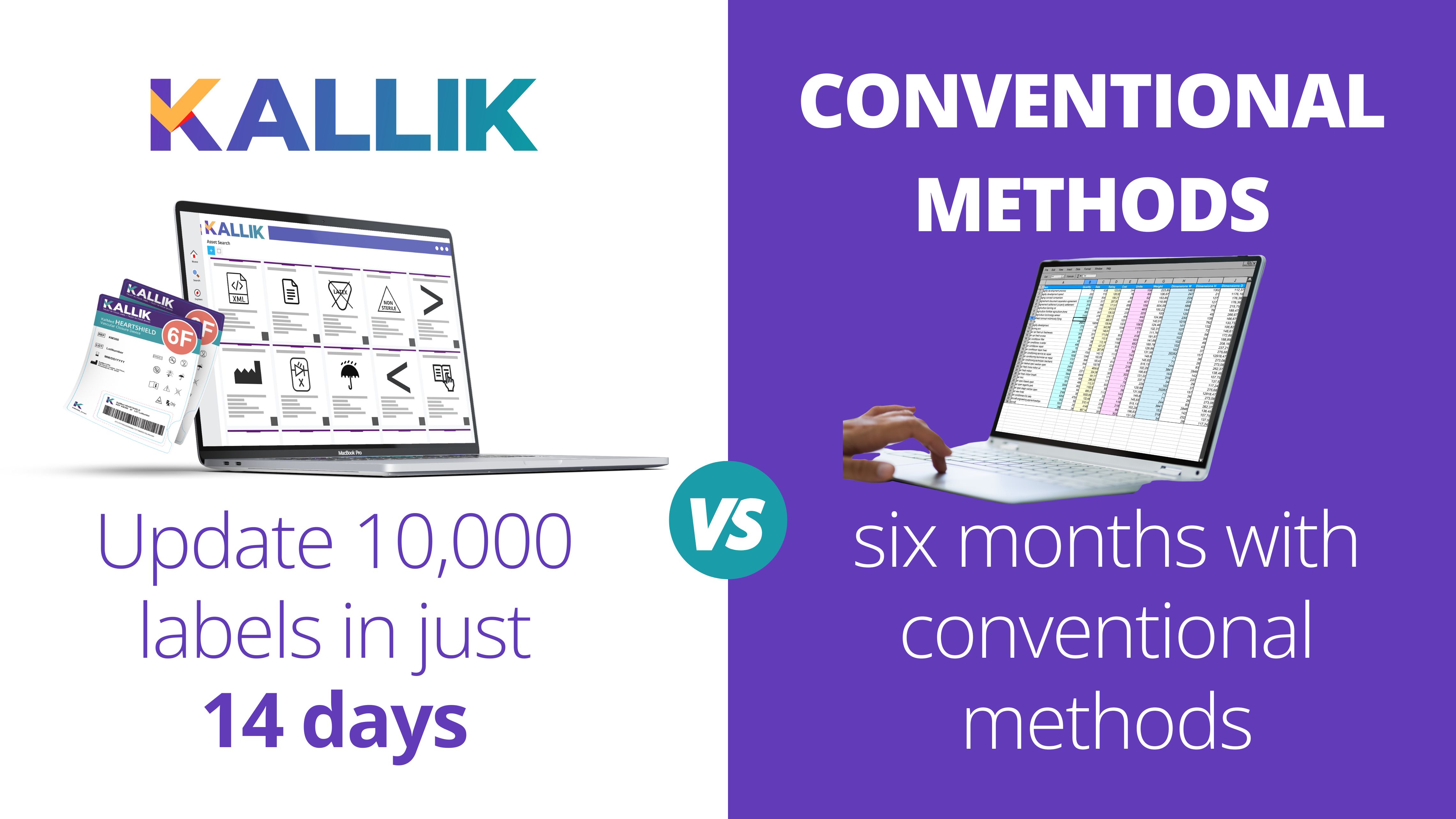
With several new labeling requirements on the horizon, you might be wondering where to start. The threat of non-compliance and the thought of months (or even years!) of hefty fees from third part organizations to guide you through these changes has probably got you wondering where to start. Well, why not speak to Kallik? Our labeling and artwork management experts are ready to help. With the ability to change 10,000 labels in as little as 14 days with the help of our automated tools and innovative technology, our end-to-end system makes it easier than ever to get ahead on new regulations.
With Kallik's Gartner-recommended software you can:
- Take advantage of our AI migration technology
- Access the platform from anywhere in the world via your browser
- Always have the latest version of our software with real-time updates
- Expereince 24/7 365 support from a team of experts
- Complete complicated tasks with one click thanks to innovative, automation features
- Prioritize sustainability and consumer safety with minimal manual input, minimizing errors
Your Partner for Compliance and Beyond
Preparing for these regulatory changes doesn’t have to be daunting. By adopting a platform that automates processes, supports digital labeling, and provides expert guidance, your business can turn compliance into a competitive advantage.
Don’t wait until 2025 to act. Start preparing now to ensure your labels are not only compliant but also a reflection of your commitment to safety, sustainability, and innovation. Want to know more? Speak to our labeling and artwork experts here, or book a demo here.
We're Now Giving Away Five Amazon Vouchers for Answering our End of 2025 Survey!
We’re running a short industry survey Nov-Dec 2025 on labeling and artwork challenges in 2025 and coming up in 2026, and we’d really appreciate your input! Your insights could help shape our upcoming 2026 industry report. If you can spare five minutes, take the survey and enter our draw for one of five $/£50 Amazon vouchers.