
The Messy Middle: Why Enterprise Labeling Teams Feel More Organised Than They Really Are
Ask most labeling teams how organized they are, and you'll get a confident answer. There's a system of record, an approval workflow, a folder structure that makes sense, at least to the people who built it. On paper, it looks like a tight operation.
Then ask a different question. Where does a product's approved copy actually live the moment someone starts a change request? Who can say, without checking three places, whether a translation was reviewed by the right person in the right market? What happens to a label variant when a regulation shifts in one country but not the other nine it's sold in?
That's the messy middle. Not the start of the process, where a request comes in and everyone knows the drill. Not the end, where a final asset gets stamped and shipped. The middle: the stretch where data gets copied between spreadsheets, approvals happen over email threads that fork into three versions, and "who owns this" quietly becomes "whoever noticed it first."
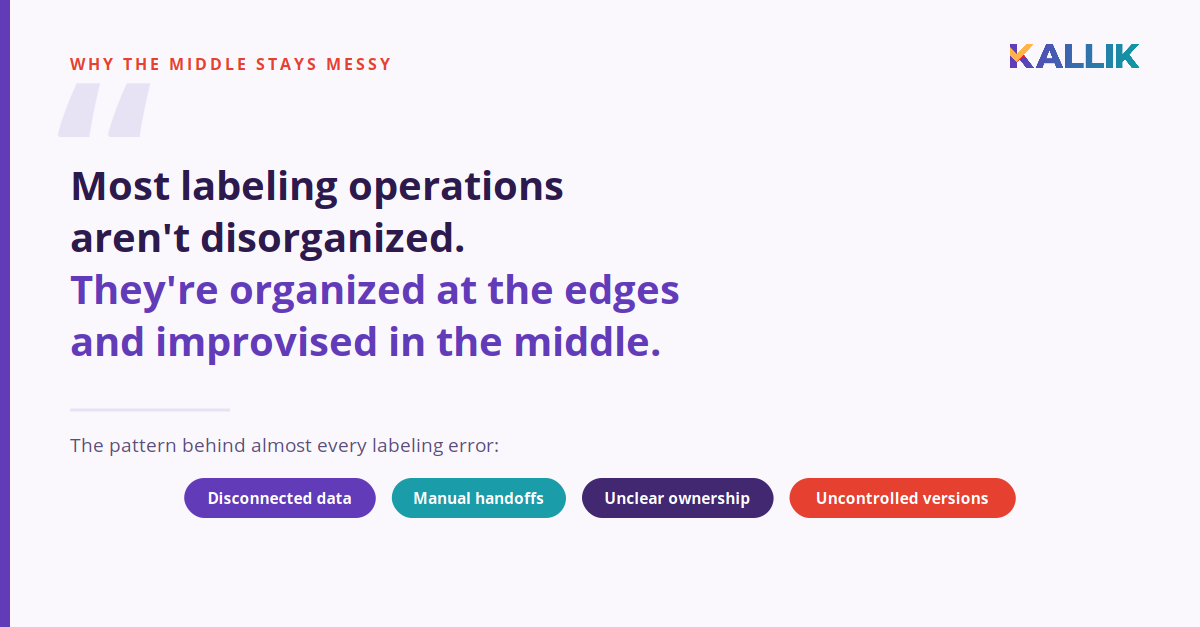
Most labeling operations aren't disorganized. They're organized at the edges and improvised in the middle. And that gap is exactly what's standing between them and genuine AI readiness.
Why the middle stays messy even in mature teams
This isn't a failure of effort. It's a structural side effect of how labeling operations grow. A company starts with one product line and one market, and a shared drive is genuinely fine. Then it's ten markets, then fifty, then a few thousand SKUs, each with its own regulatory quirks, language requirements, and approval chain. Nobody sits down one day and designs for that scale. It arrives gradually, and the tools that worked at the start get patched, not replaced.
The result is a labeling operation that's a patchwork of genuinely good systems stitched together with manual work. A proper label management platform for the master content. A separate tool for artwork. Email for approvals that don't fit either. A spreadsheet somewhere that's become load-bearing, even though nobody would admit it in a steering committee.
Regulators have seen the consequences of this for years. Mislabeling and packaging errors are a routine, repeatable cause of product recalls, not a rare edge case, and the pattern behind them is almost always the same: disconnected data, a manual handoff that should have been automatic, unclear ownership at the point of change, or a version that slipped through because nobody could see it had already been superseded. None of that shows up on an org chart. It shows up in the middle.
Why AI makes this worse before it makes it better
Here's the part that catches most teams off guard. Artificial intelligence and automation don't fix a messy middle – they amplify it.
Think of it like handing a very fast, very literal assistant the keys to your current process. If your approved content, your translations, and your regulatory rules already live in one governed place, that assistant becomes genuinely useful: it can flag the label variant affected by a rule change, draft the update, and route it to the right reviewer, all before a human would have finished searching for the source file. If your approved content is scattered across drives, inboxes, and someone's "final_v3_ACTUAL" folder, that same assistant will happily automate the confusion. It will move faster, with more confidence, in exactly the wrong direction.
This is the uncomfortable truth behind most AI readiness conversations. The question was never "do we have access to AI tools." Most companies do, or will within a year. The real question is whether the foundation underneath them, the data, the ownership, the audit trail, can support automation without quietly multiplying the risk. Gartner's recent research into enterprise disruptors points at exactly this shift: domain-specific AI models and digital trust platforms are moving up the priority list, precisely because generic automation on top of ungoverned data creates more exposure, not less.
A useful way to picture it: a tidy desk doesn't tell you anything about the drawer underneath it. Plenty of labeling operations have a tidy desk – dashboards, KPIs, a clean-looking process map for the auditors. The drawer is where the real work happens, and it's rarely as tidy as the desk suggests.
What "AI-ready" actually looks like in a labeling operation
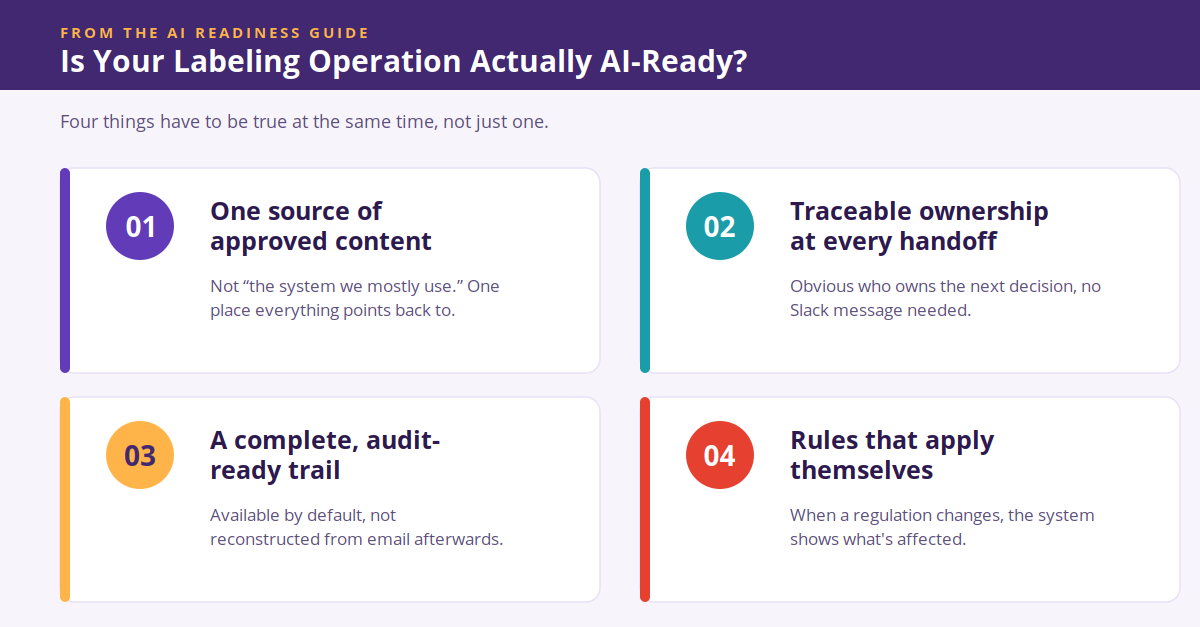
Genuine AI readiness in this world isn't about which tool you've licensed. It's about whether four things are true at the same time:
One source of approved content
Not "the system we mostly use." One place where the current, approved version of every piece of content lives, with everything else pointing back to it.
Traceable ownership at every handoff
When content moves from drafting to regulatory review to market approval, it should be obvious who owns the next decision, without a Slack message asking "does anyone know where this is at."
A complete, inspection-ready audit trail
Not reconstructed after the fact from email search. Available, by default, showing what changed, who approved it, and which markets and products it touched.
Rules that apply themselves
When a regulation changes for one market, the system should be able to show exactly which labels are affected, rather than relying on someone remembering to check.
Companies that get this right see the difference in very concrete terms. Diversey, for example, needed to control thousands of multilingual labels across more than fifty countries without adding another layer of manual oversight.
By bringing content, approvals, and artwork workflows into one governed system, the business now manages around 13,000 European artworks in a single place and has doubled artwork capacity across Eastern Europe without adding headcount. That's not a story about buying an AI tool, but rather a story about fixing the middle first, so that automation had something solid to build on.
The honest self-check most teams haven't done
Here's the thing about the messy middle: it's genuinely hard to see from inside your own organization. You know your systems. You know the workarounds so well they stopped feeling like workarounds years ago. The gap between "we feel organized" and "we could survive an audit, a recall, or an AI rollout without finding a nasty surprise in the middle" isn't something a dashboard shows you.
That's the exact gap we built our AI Readiness Guide to close. It's a practical way to see where your labeling operation genuinely stands: what's solid, what's improvised, and what would break first if you tried to automate on top of it today. There's a short self-assessment too, so instead of guessing, you get a straight answer about where the real risk sits.
We've spent years inside exactly this problem with regulated manufacturers, which is honestly the only reason we could build something this specific. If your team has ever quietly wondered whether "organized" and "audit-ready" are actually the same thing, this is worth twenty minutes of your time before you commit to an AI roadmap, not after.