
PPWR Lands Next Week and Most Companies Still Can't Answer the Basic Questions
Six days before PPWR takes effect, the biggest risk to most companies isn't the regulation itself. It's that they can't tell you what's actually in their own packaging.
That's exactly the gap Packaging Europe reported on this week, in a piece warning of the huge financial risks involved in PPWR compliance failure.
It's true and the timing makes it hard to ignore. The EU's Packaging and Packaging Waste Regulation generally applies from August 12, 2026. Based on what we see across pharma, cosmetics, chemicals and FMCG, a lot of companies are heading into it with fragmented packaging records, no single owner for the problem, and no fast way to answer "what do we actually put on the market, and where" without someone spending days pulling files together by hand.
So what is PPWR, actually?
Strip away the acronym and PPWR is a regulation that sets new requirements for recyclability, minimum recycled content and packaging labeling across the EU, and it requires producers to report exactly what they're placing on the market so extended producer responsibility (EPR) fees can be calculated. It doesn't operate alone. It sits alongside separate national EPR schemes, and in the US, a growing list of state laws doing something similar. As of July 2026, seven US states had already passed their own packaging EPR legislation, covering roughly 20% of the population, with more states reviewing their own versions.
None of these frameworks wait for each other, and none of them share a format. That's the part that trips companies up. It isn't one deadline, but rather a stack of them, in different countries, measured in different units, with different fee schedules and different penalties, and usually no one person whose job it is to see all of them at once.
The consequences are real
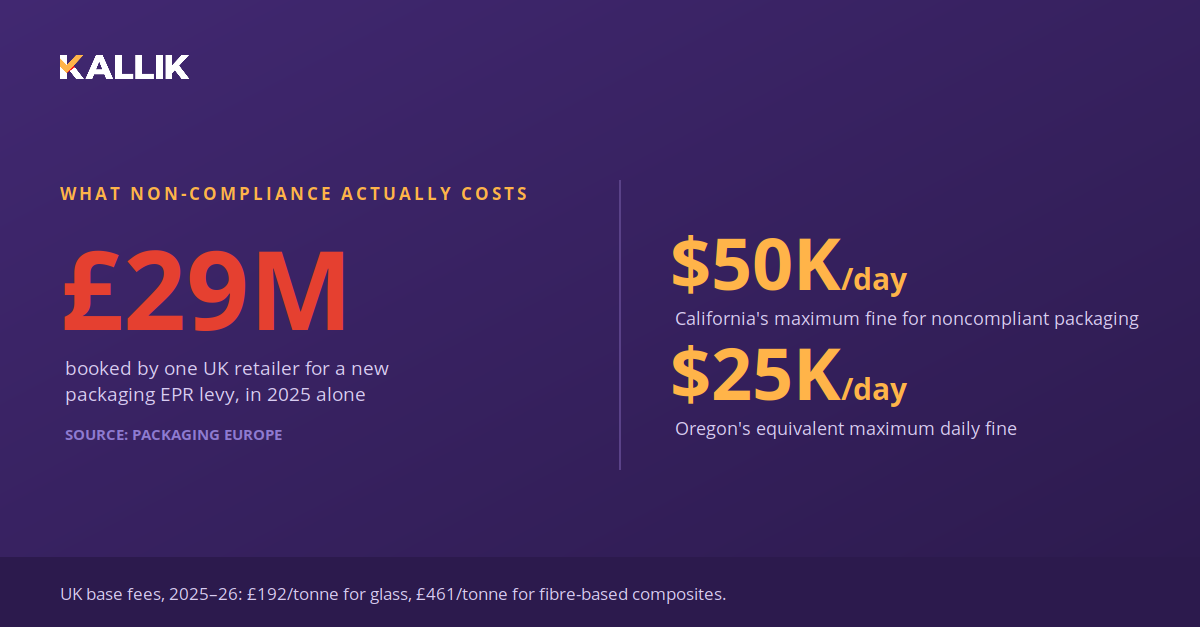
This isn't theoretical. As John Blake, Senior Director Analyst at Gartner, points out in Packaging Europe’s piece, one major UK retailer booked a £29 million charge in its 2025 interim results for a new packaging EPR levy alone. UK base fees for 2025 to 2026 sit at £192 per tonne for glass and £461 per tonne for fibre-based composites. In the US, California can fine up to $50,000 a day for noncompliance, Oregon up to $25,000 a day, and both PPWR and California's SB 54 carry the possibility that noncompliant packaging simply gets pulled from the market. Run those figures over a few weeks of continuing violations and you're no longer looking at a line item. You're looking at a board conversation.
We see this from the other side of the table too. A good number of the companies that come to us do so after something has already gone wrong: a recall, a fine, a shipment held at a border because the packaging didn't match what was declared on the label. The cost in those cases is never just the penalty. A recall damages trust with retailers and regulators in a way that takes years to rebuild, and in pharma, life sciences and cosmetics specifically, a packaging or labeling failure isn't only a compliance problem or a reputational one. It can put someone's health at risk.
Why the data is the actual problem
What we hear most often from clients is that the compliance requirement itself usually isn't the hard bit. It's that most companies don't hold their own packaging specification data in a form that's complete, current and easy to retrieve. Material type, weight, format, recycled content percentage. It exists somewhere. It's just spread across old spec sheets, supplier emails, product development files and whatever the last person to touch that SKU happened to save. When a regulator asks for it, someone has to go find it, and there's rarely time to do that properly before a deadline.
A genuinely useful test, and one worth trying this week: pick five SKUs at random and time how long it takes to pull a complete, verified packaging specification for each one, across every market they sell in. If that takes longer than a few minutes, that's the real risk.
Getting ahead of PPWR compliance
The fix isn't complicated conceptually, even if it's not quick to put in place. It means centralizing packaging specification data so it lives in one place instead of ten, keeping it current as formats and formulations change, and giving one named person the authority to see across every jurisdiction the company sells into, rather than leaving it to a patchwork of local teams working from different spreadsheets.
Our end-to-end, cloud-based, software, Veraciti, was built with regulatory compliance in mind – to make the process as simple as possible. It won't make PPWR itself simpler; but it does mean the data question stops being the thing standing between your team and a filing.
If PPWR week has you double-checking where your packaging records actually live, it's probably time to make a change. Don’t wait until PPWR trips you up to start improving your processes. Want to know more about how you can turn your labeling and artwork process from a headache to a competitive advantage? Speak to our labeling and artwork experts by filling in a form here, or book a demo here.