
RAPS Webinar Recap: Kallik and Gartner on Understanding Composability in Labeling and Artwork Management

RAPS Webinar Recap: Kallik and Gartner on Understanding Composability in Labeling and Artwork Management
Author Name
Kallik Role 1
Content Manager

The recent Regulatory Affairs Professionals Society (RAPS) webinar, featuring labeling and artwork experts John Blake, Senior Director Analyst at Gartner and Gurdip Singh, CEO of Kallik, discussed in depth the intricate world of labeling and artwork management and what process maturity looks like in 2024. With a focus on regulatory compliance, the webinar explored evolving industry trends, challenges faced by organizations, and transformative strategies for digital maturity.

John Blake, representing Gartner, a global technological research and consulting firm, began the discussion by underlining the pivotal role of labeling and artwork management in ensuring regulatory compliance. Providing a comprehensive overview of the evolving landscape, John emphasized the shift from traditional label and artwork management to the digital, online management of labeling and artwork and how this digitalization is seeing artwork and labeling merge as the two become more difficult to separate.

The stages of maturity

The topic of maturity then came up as John went on to discuss the maturity levels within organizations, highlighting the common challenges faced in the early stages. Focusing on companies stuck in what is described as the second stage of maturity, John said: “I would say, regardless of industry, regardless of size of company, the vast majority of organizations and functions within those organizations are just at that stage of identifying that they have a problem. You know, delays, cost overruns, recalls, they’re at that firefighting stage.”

Then discussing the third stage of maturity, where organizations tend to introduce tools and technology but in a very siloed fashion, it then becomes about how to communicate and collaborate better across the organization. “We see the vast majority of companies in these earlier stages, regardless of industry or size of the company.”

Moving up the maturity stages

John goes on to look at the opportunities being missed within the label and artwork management process and how removing traditional processes can benefit businesses. “I think about what we have in our homes, our pictures are stored on the cloud, we have cameras in our doorbells, we are streaming music online. But then we go into work, back into our business operations and there are still a tremendous amount of manual processes, from spreadsheets to back and forth over emails and even printed copies for approvals. There’s a real opportunity in the label and artwork management space to bring those digital tools into those processes.”

The importance of composability

Introducing the concept of composability, John illustrated the importance of discoverable data and autonomy in updates. Using the analogy of music, he highlighted the power of composability in business processes. “I would have to go find the music I want to put on a CD, I’d have to find a blank CD and I’d have to find a CD burner. I’d then have to mail a physical copy out too. So quite honestly, that would probably take about two weeks to do. But with the introduction of streaming services, which is also digital music, it's composable. I could give you the name of a song or an artist, I wouldn't even have to spell it correctly, and you could find it and be listening to it in seconds.”

With the emergence of cloud-based, collaborative, automated systems that offer composability, the way that organizations manage their label and artwork processes is transforming. Eliminating mistakes, saving time and money and offering complete regulatory confidence, the future of label and artwork management is clearly in these digital solutions.

John summarized: “The legacy systems can just no longer keep up. It's costing organizations too much time, too many resources, and certainly the inability for systems to break down those silos, it’s just causing businesses too many problems.”

Gurdip Singh, Kallik’s CEO, then took over to offer his expertise on the benefits of cloud-based, digital platforms. Gurdip stressed the global significance of labeling, extending beyond physical labels to encompass critical information impacting billions of lives daily.

How labels and artwork keep the world spinning

Recalling a recent conversation with a customer, Gurdip emphasized the importance of ensuring your label and artwork process is up to scratch. “He said to me that if all of the labeling companies around the world just decided to stop one at any point in time, it wouldn't be very long before the world came to a standstill. And I thought, actually, that's a really, really important point. Every product that is out there has labeling around it.

“It's not just about the physical label on the product itself, it's the information on that product. The information for you, the packaging that goes around it - if you didn't know how to use that product, let's say, in a medical situation, a clinician using a piece of apparatus without the right instructions, then it could cause serious harm.” Although there are significant time and cost savings to be made when properly utilizing digital platforms for the process, it could ultimately save lives by preventing dangerous mistakes and helping to ensure compliance.

Making mass changes accurate and compliant

Discussing the difficulties of making mass changes across tens of thousands of labels and artwork while maintaining that accuracy and compliance, Gurdip went on to reiterate that composability is the answer. “The enterprises that we work with can have around 80-90, 000 changes taking place. In fact, we had one global medical device company that alone had to make 90, 000 changes in one year just to be compliant with European Union medical device regulations.

And just trying to find those in your ecosystem, let alone change them can be quite a daunting task. As a result, things become slow. You miss out on, you know, really getting value, your product out there, generating further income, generating further revenue and also getting products out there faster.” Gurdip then emphasized the need for proactive investments in labeling and artwork processes, shifting from reactive fixes to a holistic digital maturity approach.

Teleflex: A label and artwork success story

Reiterating the significance of the digital maturity model, Gurdip emphasized the shift beyond basic organization towards optimization, integration, and strategic significance in businesses. Recognizing some of the most common challenges, such as informed mindsets, reactive behavior, and the complexity of involving multiple stakeholders, Gurdip talked through a customer success story with a medical device provider, Teleflex. By using Kallik’s platform, Veraciti, Teleflex were able to completely eliminate mistakes, preventing product recalls thanks to the composability provided by a cloud-based, automated solution. This highlighted just how crucial composability is and how the digital transformation of the labeling and artwork process is enabling composability, ultimately providing organizations with complete accuracy, regulatory confidence and reducing the time-to-market.

Overall, the RAPS webinar brought together insights from Gartner and Kallik to offer a comprehensive perspective on the challenges and opportunities within the artwork management and labeling space. As organizations navigate the complexities of regulatory compliance, the key takeaways include the importance of composability, the digital transformation and the requirement for proactive investment in advanced solutions to drive efficiency and address regulatory challenges effectively.

Missed the webinar? Watch the full recording here.

Looking for advice on how to improve your label and artwork process? Get in touch with a Kallik expert today by emailing enquiries@kallik.com.
Kallik’s Guide to Mastering Enterprise Labeling & Artwork in 2024

Kallik’s Guide to Mastering Enterprise Labeling & Artwork in 2024
Author Name
Kallik Role 1
Content Manager

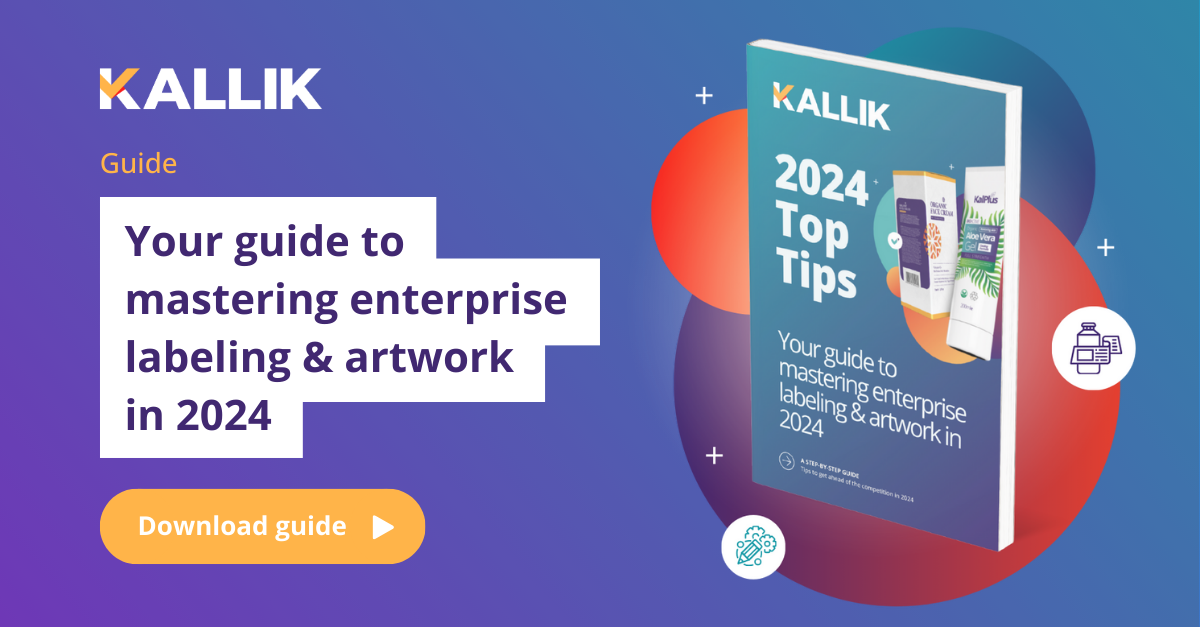
In a world where regulations tighten, consumer demands evolve, and sustainability takes precedence, the Labeling and Artwork industry is undergoing a profound digital transformation. Our comprehensive guide (Top Tips: Your Guide to Mastering Enterprise Labeling & Artwork in 2024) delves into this revolution, offering insights from industry experts and real-world success stories that highlight the crucial role of digitalization.

Embracing the Digital Revolution

The shift from traditional processes to cloud-based, automated platforms in labeling and artwork management (LAM) has become a strategic imperative for organizations navigating regulatory complexities and adapting to changing market landscapes. Cloud-based solutions have emerged as the cornerstone, enabling global collaboration, instant updates, and enhanced security. According to Gartner, by 2025, an estimated 85% of businesses will have adopted cloud-based technologies into their daily operations—a trend that's reshaping the industry's standards and capabilities.

The Power of Artificial Intelligence and Automation

Integrating AI-driven systems has revolutionized accuracy and speed in LAM, significantly reducing errors and facilitating swift adaptations to regulatory changes. Automated artwork creation and modification, often taking just seconds, have replaced weeks of manual revisions. The transformative impact of AI isn't just about efficiency; it's about achieving complete regulatory compliance and instilling confidence in labeling accuracy.

Template Technology: A Game-Changer in Efficiency and Compliance

Template technology offers agility, scalability, and compliance, leading to significant cost savings and ensuring precision in label and artwork management. Its impact extends beyond financial implications, playing a vital role in regulatory adherence, particularly in critical industries like healthcare.

Prioritizing Personalization and Sustainability

The demand for sustainable packaging and labeling is at an all-time high. Digital platforms are enabling businesses to swiftly adapt to eco-friendly practices through customizable, pre-designed templates, ensuring operational fluidity while meeting sustainability goals.

Looking Ahead to 2024

As we move further into 2024, the evolution of LAM continues to be driven by digital innovation. The strategic adoption of cloud-based solutions, AI integration, template technology, and a focus on sustainability is shaping the future of enterprise labeling and artwork management. This digital transformation isn't just an upgrade—it's a fundamental revolution that propels businesses toward operational excellence and unwavering precision in a fast-paced global marketplace.

graphic for 2024 labeling and artwork top tips guide

Your Next Step in Mastering LAM

If you're eager to learn more about the digitalization of labeling and artwork or seek guidance on enhancing your LAM process, our comprehensive guide offers expert insights and success stories to guide your journey. Download the full guide here and take the first step toward mastering enterprise labeling and artwork in 2024.

For personalized advice and assistance tailored to your business needs, speak to a Kallik expert today by emailing enquiries@kallik.com. Your journey toward a more efficient, compliant, and sustainable LAM process begins here.

Download the full guide for expert insights and success stories in mastering Enterprise Labeling & Artwork in 2024.

Accelerating Regulatory Compliance with Automation in IFU Leaflet Production

Accelerating Regulatory Compliance with Automation in IFU Leaflet Production
Author Name
Kallik Role 1
Content Manager

In the dynamic landscape of pharmaceuticals and medical devices, regulatory compliance stands as a cornerstone of patient safety and well-being. Yet, ensuring compliance with evolving standards and regulations poses significant challenges for organizations worldwide. Traditional methods of producing Instructions For Use (IFUs) and Patient Information Leaflets (PILs) have often proven inadequate in meeting these demands. 

These documents serve as crucial sources of information for patients, providing guidance on the proper use of medical devices and medications. Inaccuracies or errors in these leaflets can have severe consequences. When it comes to pharmaceutical and medical device labeling, the risks can even be life threatening.

Therefore, ensuring the accuracy and compliance of patient information and instructions for use leaflets is essential for safeguarding patient health and maintaining regulatory adherence. However, with the introduction of automation in the labeling and artwork industry, a new era of efficiency, compliance and accuracy has arrived in IFU production.

Bob Tilling, our label and artwork expert, sheds light on the transformative power of automation in IFU production. Let's discuss some of the insights Bob has shared:

Addressing Regulatory Gaps

Having anything from 100 to over 1,000 IFUs is not uncommon for a mid-sized device manufacturer. Re-writing in a style appropriate for the user, the addition of new symbology and statements, plus translation into 20+ EU languages is making the task of updating these to comply with the new EU Medical Device Regulation (EU MDR) much larger than first anticipated for many device companies.

The new EU MDR is significantly longer than the EU Medical Devices Directive (MDD) and will require most medical device manufacturers to update their clinical data, technical documentation and labeling which includes the leaflets.

Non-compliance with EU MDR labeling requirements not only puts patients at risk but also exposes organizations to legal repercussions and reputational damage. Therefore, ensuring the accuracy and compliance of patient information and instructions for use leaflets is essential for safeguarding patient health and maintaining regulatory adherence.

Many organizations recently have found themselves in a quandary, as traditional systems, including Product Lifecycle Management (PLM) systems, often fall short in controlling layout and content. Veraciti emerges as a beacon of hope, offering a comprehensive solution that not only manages content but also controls layout, ensuring compliance with regulatory standards.

Streamlining Processes, Eliminating Errors

The traditional approach to IFU production often involves a laborious process that involves input from several stakeholders across the globe. This decentralized approach not only consumes time but also increases the risk of errors. By using an automated enterprise labeling software, such as Kallik’s Veraciti, you can revolutionize this process by automating the generation of the leaflet from a pre-approved single source of truth with pre-approved, automatic translations available too, eliminating the need for manual intervention when creating and updating the leaflets.

Breaking Language Barriers, Ensuring Consistency

When it comes to IFU leaflets, it’s crucial that the information can be correctly understood by patients and healthcare professionals all over the world. Veraciti revolutionizes this process by enabling organizations to swiftly generate IFUs in multiple languages, all within a matter of seconds. This groundbreaking capability eliminates the necessity for linguistic expertise, a significant obstacle particularly for non-native speakers who may struggle with language nuances.

Unlike competitors who rely on less accurate methods like Google Translate, Veraciti offers pre-approved translations derived from a single source of truth, ensuring consistency and accuracy across all IFUs. This not only streamlines the process but also reduces the workload, as organizations no longer need to create separate IFUs for each language, enhancing accessibility. The ability to swiftly generate accurate translations is a game-changer, empowering non-native speakers to access vital medical information with ease and confidence, ultimately contributing to improved healthcare outcomes on a global scale.

Making the Move to eIFUs (Electronic IFU)

In today's fast-paced digital world, the transition from traditional paper-based IFUs to electronic formats marks a significant leap forward in efficiency and accessibility. Electronic IFU leaflets offer a long list of benefits, including streamlined access, enhanced user experience, the ability to deliver multilingual content seamlessly and not to mention the sustainability benefits. Furthermore, when regulations are updated and the information required on IFUs changes with them, this then can mean that organizations need to change thousands of labels to stay compliant. With electronic IFUs, the process is far less time consuming and involves far less waste. As Peter Muller explains in Med-Tech Intelligence: “Paper-based IFUs/PILs are printed in bulk leading to waste when product/manufacturing information or safety advice needs to be updated. There may also be a level of risk to patients if they are accessing information that has been superseded.”

With this rising demand for electronic IFUs, organizations are increasingly turning to automation. Unlike traditional methods that rely on manual processes and paper-based documentation, Veraciti empowers organizations to generate IFUs in electronic formats, including XML files. This capability not only ensures compliance with regulatory standards but also opens up a world of possibilities in terms of accessibility and integration. With Veraciti, organizations can create IFUs that can be downloaded as XML files, enabling seamless integration into websites and digital platforms. By harnessing the power of automation and electronic IFUs, organizations can navigate the complexities of regulatory compliance with ease while delivering an unparalleled user experience to their customers.

Case Study: Empowering Össur With Greater Control

Our collaboration with Össur, a leading provider of Class II medical devices, exemplifies the transformative impact of automation in IFU production. Össur faced numerous challenges, including disparate legacy systems, delays in product launches, and limited control over IFU assets. With the implementation of Veraciti, Össur achieved remarkable results, consolidating IFU phrases into a centralized system, enhancing visibility, and streamlining the approval process. The ability to pre-approve phrases and standardize IFUs has not only improved efficiency but also ensured compliance with regulatory requirements. You can read more about how we helped Össur here.

Success Story: Keeping People Safe with Cardinal Health

In our collaboration with Cardinal Health, a global leader in healthcare services, we have witnessed firsthand the critical importance of accuracy and compliance in IFU production. By providing solutions that streamline the compliance process and eliminate errors, we have helped Cardinal Health navigate the complexities of regulatory standards, particularly in the context of MDR compliance.

As Bob Tilling aptly puts it, "The ability to pinpoint necessary artwork modifications swiftly and accurately is instrumental in not just compliance but also in ensuring accuracy in crucial elements such as Instructions for Use (IFUs)."

Safeguarding Lives, Ensuring Compliance

Through adopting our approach, creation of multiple language EU MDR compliant 30 page IFUs is down from 3-5 hours to just 30-40 minutes with the time taken to generate individual labels reducing from 1 hour to around 10 minutes. With 350 IFUs and 10,000 labels, 5 person years of lost time has been recovered just for Class III devices alone.

In conclusion, automation in IFU production is a game-changer for compliance, accuracy and efficiency. By leveraging the power of technology, organizations can streamline processes, eliminate errors, and ensure compliance with regulatory standards. Our partnerships with Össur and Cardinal Health underscore our commitment to empowering organizations with complete regulatory confidence.

Want to see the power of cloud-based labeling and artwork management software for yourself? Whether you’re in the food and beverage, pharmaceutical, medical device, chemical, or even the cosmetic industry, our experts are ready to help you transform your labeling and artwork management with the help of our innovative software, leading the way in the labeling and artwork software space. 

Get in touch today to see what we can do for you at enquiries@kallik.com or call +44 (0) 1827 318100.