Regulatory Label Changes: From Months to One Edit

Regulatory Label Changes: From Months to One Edit
Author Name
Kallik Role 1
Content Manager

PPWR recently became enforceable across the EU and despite most teams knowing it was coming, plenty still weren't ready. For the most part, this was not because they had misread the regulation, but rather because they just couldn't move fast enough once they knew what it meant.

Regulations affecting packaging are being introduced and updated all the time with sustainability and patient safety (quite rightly) becoming increasingly scrutinized. We’ve mapped out some of the biggest and most pressing ones in our latest free resource, but it takes a lot more than being aware of the regulation to be prepared for the regulation – especially when it could change again at any moment!

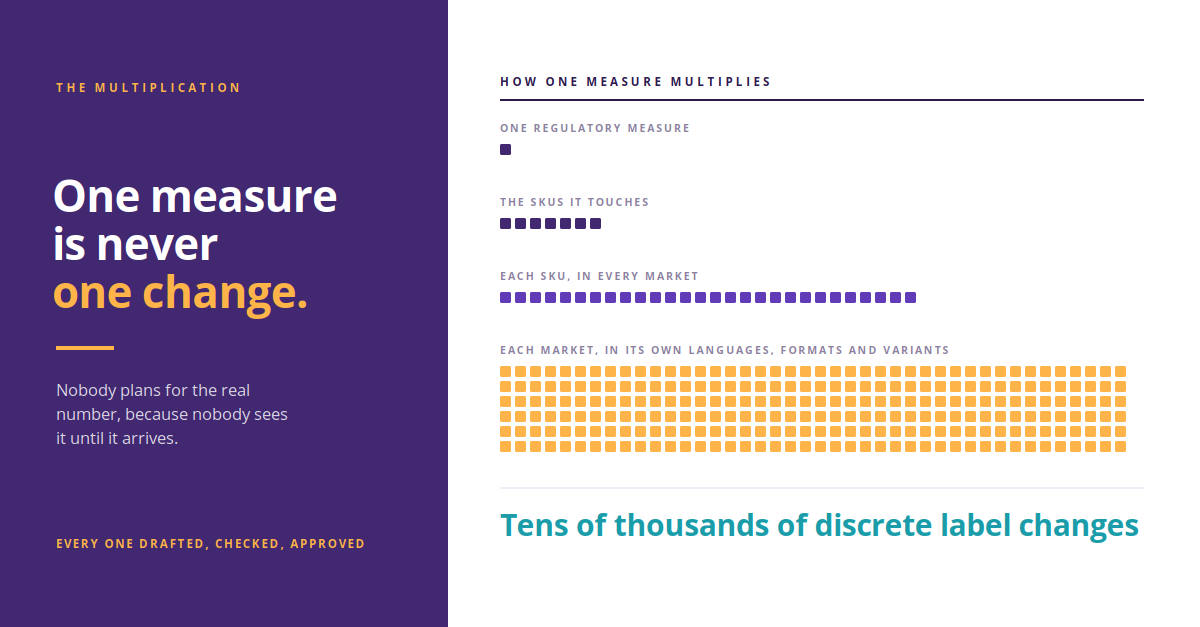
And if that’s not enough to have your regulatory affairs team stressed out, then do the multiplication and realize that each measure touches a set of SKUs and each SKU appears in several markets and each market wants its own languages, its own pack formats, its own regional variants. Seventeen regulations suddenly become tens of thousands of discrete label changes, all of which needs drafting, checking, approving and evidencing. Unfortunately, we often find that nobody plans for that number because nobody sees it until it arrives.
 

Download the free PDF


Why Packaging Updates Are Simpler Than You Probably Think


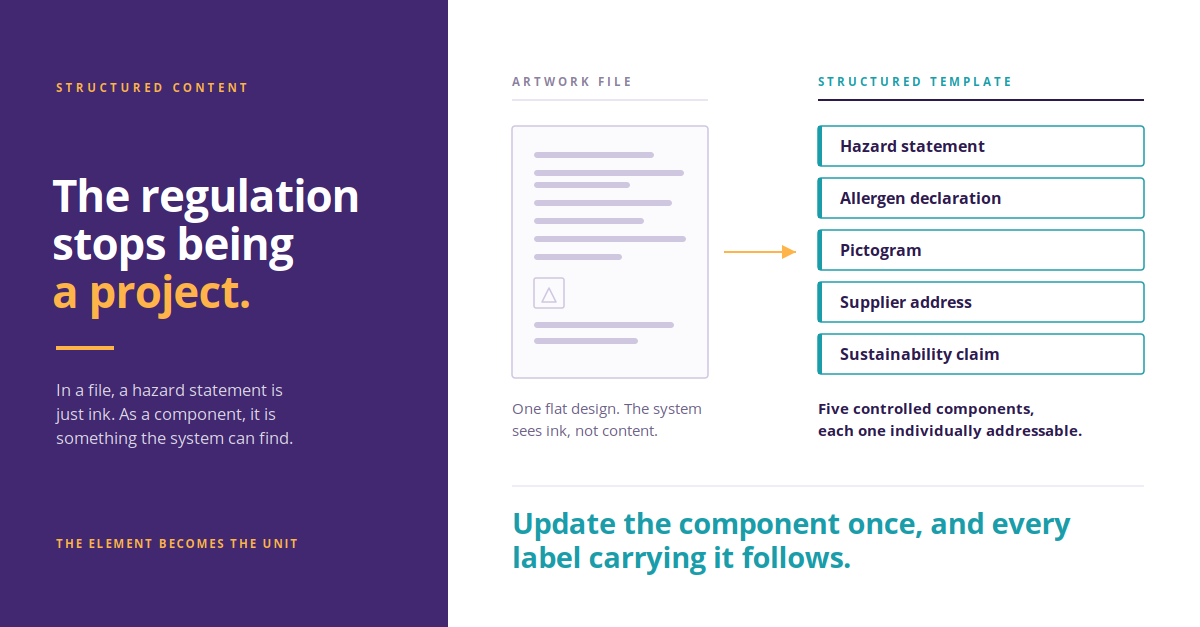
If you strip away the legal text, the reality of a regulation update is that a controlled element on your label has changed. Whether it’s a hazard statement, an allergen declaration, a supplier address, a sustainability claim, the work underneath is the same. This therefore raises the question: if the work is the same every time, why does every regulation land like a brand new crisis for so many businesses?


Your Process is Holding You Back


Most organizations still hold their labels as artwork files. Unfortunately, in that world, a hazard statement is not something your system knows about or can easily locate and update for you. So when the statement changes, you can't update the statement. You can only open files and go looking for it.

Which is why the first few weeks (or even months) of every regulatory project are spent on a question that has nothing to do with regulation: which of our labels does this actually affect? Somebody builds a spreadsheet while somebody else cross-references it against the product master and then a third person finds four SKUs that were missed, usually late, usually in a market nobody thought about. And then this all gets repeated in full, from scratch, every single time. Sound familiar?


What Changes When the Element is the Unit


Now imagine the same seventeen measures landing on a library where every phrase, symbol, pictogram, warning and image is stored as its own approved, reusable asset, and templates assemble those assets into finished labels. You already know where every element is used, because the relationship is data rather than memory.

Update the hazard statement once, with one simple click, and it flows to every label that carries it, in every language, with the version history sitting behind it. The regulation stops being a project and instead becomes a simple edit. That is the difference between a team that spends 2027 reacting and a team that spends it prepared. Which would you prefer?


Where Kallik Comes In


Veraciti™ was built for regulated manufacturers from the start rather than adapted for them later, and it shows in the parts that usually hurt most.

Where Used answers the scoping question instantly, so the two weeks of archaeology never happen. Cloud Designer lets your own people build and amend labels without specialist desktop software or a third-party studio on retainer. And the approval workflows were designed around genuinely regulated sign-off, with the audit trail produced as a byproduct of the work rather than reconstructed afterward for an inspector.

The objection we most often hear when it comes to switching from emails and spreadsheets to a fully end-to-end software like ours is: migration. Twenty years of accumulated artwork files, and the reasonable fear that moving them will be long, complicated and painful. That is exactly why we built AToM, an AI-driven tool which digitizes existing labels into structured, reusable components automatically and accurately. 

We help our customers to reach full regulatory compliance and hold it there. The days of headaches and stress from regulatory updates are gone, and instead of hiring a team to help you manage the changes, you can simply make thousands of changes with the click of a button. 


See the Full Picture and Stay Ahead 


We've put some of the biggest and most important regulation updates in a single infographic, grouped by industry, mapped by market and sequenced by deadline. It's free, it's detailed, and it's the clearest view we've found of what the next few years actually look like.

Interested in learning more? Why not book in for a free, no-obligation chat with one of our label and artwork management experts by calling +44 (0) 1827 318100, emailing enquiries@kallik.com, or filling in a form here. Alternatively, learn more about how Kallik works here.
 

Download the free PDF

FAQs about regulatory label changes

Why do regulatory label changes take so long? 

Most of the time goes on scoping rather than on the change itself. When labels are held as artwork files, a hazard statement or allergen declaration exists only as ink inside a PDF, so the system cannot tell you which labels contain it. Teams build spreadsheets, cross-reference them against the product master, and still miss SKUs in markets nobody thought about — and the whole exercise is repeated from scratch for every new regulation.

What is structured content in label management? 

Structured content means storing every phrase, symbol, pictogram, warning, and image as its own approved, reusable asset, with templates assembling those assets into finished labels. The label becomes a set of relationships between controlled elements rather than a flat design file. That is what allows a change to one element to flow through to every label that carries it, in every language, with the version history behind it.

How do you find every label affected by a regulation change? 

If labels are stored as structured content, the system already knows where every element is used, because the relationship is recorded as data rather than held in someone's memory. A query returns every artwork containing a given phrase or symbol in seconds. In Kallik's Veraciti™, the Where Used feature does this and pulls the affected labels into a single project, so they can be updated together and approved in one sign-off rather than opened one at a time.

What is the difference between an artwork file and a label template? 

An artwork file is a finished design, and the regulatory content inside it is not separately identifiable to the system. A label template is a structure that assembles approved, individually controlled components into a finished label. The practical difference shows up when something changes: an artwork file has to be found and edited by hand, while a template updates automatically when the component it references is updated.

What happens to existing artwork when moving to a structured labeling system? 

Existing artwork does not have to be rebuilt by hand. Kallik's AToM is an AI-driven migration tool that reads existing labels and artwork, breaks them down into their areas of content, and builds structured, reusable templates automatically. It identifies and removes duplicate phrases and symbols along the way, so the result is a deduplicated library rather than a copy of the original file store.
 

What Is Label Artwork Management Software? A Buyer's Guide

What Is Label Artwork Management Software? A Buyer's Guide
Author Name
Kallik Role 1
Content Manager

One out-of-date hazard symbol can hold a shipment at customs. One mismatched ingredient statement can trigger a recall across three continents. For organizations managing thousands of SKUs across dozens of markets, label and artwork accuracy is a major business risk.

Most companies only start shopping for label artwork management software once that risk becomes visible. This guide explains what the software actually does, which features matter, and how to compare vendors before you commit.

What is label artwork management software?

Label artwork management software is a centralized platform that manages the full lifecycle of product labels and packaging artwork – content creation, translation, review, approval, version control, and print-ready output – in one controlled system. It replaces the spreadsheets, shared drives, email approval chains, and disconnected design tools that most organizations begin with, giving every team a single source of truth for label content and artwork.

The strongest platforms combine two capabilities that are often sold separately: artwork management (design, proofing, approval workflows) and labeling management (structured content, phrases, symbols, regulatory data). Keeping them in one system is what removes the copy-paste errors that cause compliance failures.


Who needs it?

Label artwork management software is built for regulated and high-complexity industries, including:

  • Pharmaceuticals and life sciences
  • Medical devices and IVD
  • Chemicals, oil, and lubricants
  • Cosmetics and personal care
  • Food, beverage, and consumer goods

If your business faces multi-market regulatory change, frequent artwork revisions, or audits that require a defensible history of every label version, manual processes will eventually become the bottleneck.


Core features to look for

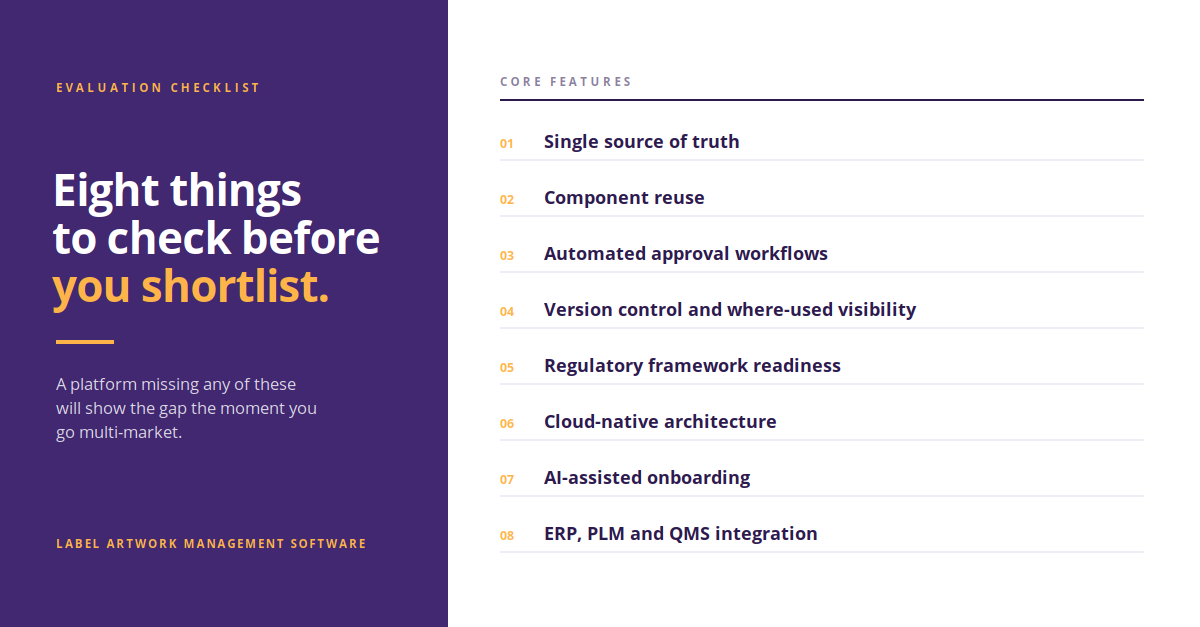
Use this as your evaluation checklist:

Single source of truth: one governed repository for all label content, artwork, images, and symbols.

Component reuse: approved phrases, warnings, and symbols reused across SKUs instead of recreated each time.

Automated approval workflows: routed reviews with electronic signatures and full audit trails.

Version control and "where used" visibility: instantly see every product affected by a single content change.

Regulatory readiness: support for frameworks such as EU MDR, 21 CFR Part 211, CLP, and Digital Product Passports.

Cloud-native architecture: global access, faster deployment, and no infrastructure burden.

AI-assisted onboarding: automated migration of legacy labels so implementation is measured in weeks, not years.

Integration: connections to ERP, PLM, and QMS so label data stays synchronized with product data.

Shortlist

Label artwork management vs. label printing software


These categories are frequently confused, and the difference matters when you build your shortlist.

Label printing software vs. label artwork management software
CriteriaLabel printing softwareLabel artwork management software
Primary purposeDesign and print barcodes and labelsGovern the entire label and artwork lifecycle
Approval workflowsMinimal or manualAutomated, audited, signature-controlled
Best fitSmall to mid-sized, print-focused operationsGlobal, regulated, multi-SKU enterprises
Compliance evidenceLimitedFull audit trail and version history

If your requirement is simply printing labels on the production line, printing software may be enough. If you need to prove why a label says what it says, you need artwork management.


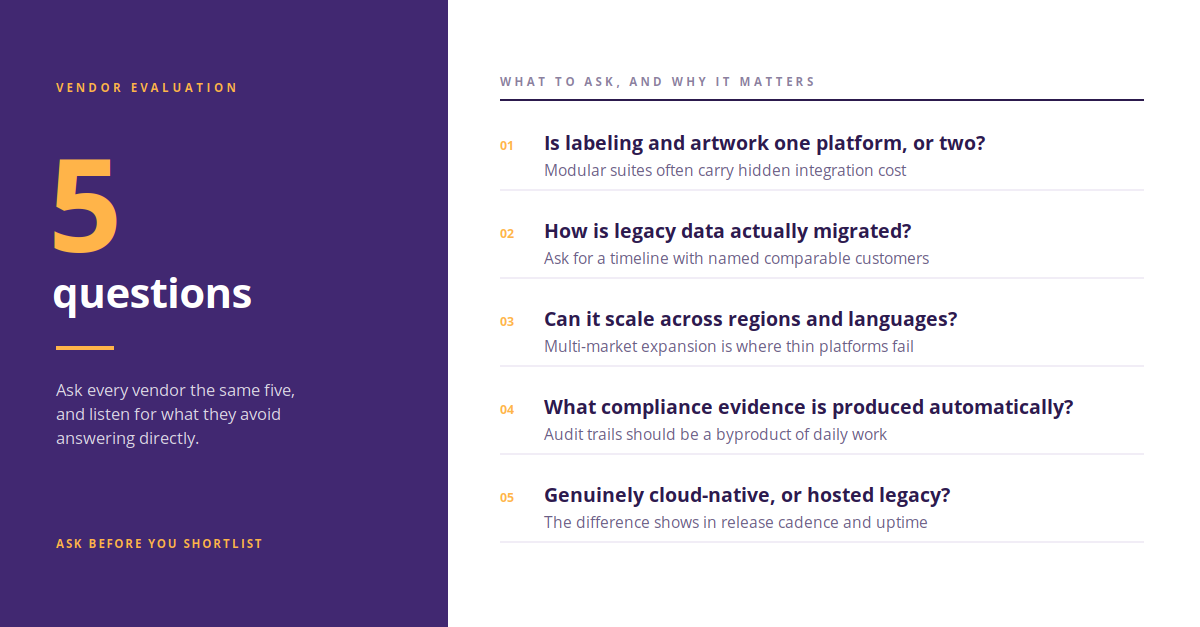
Five questions to ask every vendor

  1. Is labeling and artwork one platform or two integrated products? Modular suites often carry hidden integration cost.
  2. How long does implementation take, and how is legacy data migrated? Ask for a realistic onboarding timeline with named comparable customers.
  3. Can it scale across regions and languages? Multi-market expansion is where thin platforms fail.
  4. What compliance evidence does it produce automatically? Audit trails should be a byproduct of daily work, not a manual exercise.
  5. Is it genuinely cloud-native, or a hosted legacy system? The difference shows up in release cadence and uptime.

To see how leading platforms stack up on these criteria, compare Kallik vs. Loftware, Kallik vs. Esko, and Kallik vs. BarTender.

Vender Evaluation


The bottom line

Label artwork management software pays for itself in avoided rework, faster time to market, and audit confidence. The right choice depends on your scale and regulatory exposure: smaller, print-led operations may be well served by lighter tools, while global regulated enterprises need a unified platform built for complexity.

Kallik's Veraciti™ brings labeling and artwork together in one cloud-native platform designed for regulated industries. Book a demo to see it applied to your portfolio.


FAQs on label artwork management software

What is label artwork management software? 

Label artwork management software is a centralized platform that controls the full lifecycle of product labels and packaging artwork, including content creation, translation, review, approval, version control, and print-ready output. It gives regulated organizations a single source of truth and an audit trail for every label change.

What is the difference between artwork management and labeling management? 

Artwork management covers the visual design, proofing, and approval of packaging and label artwork. Labeling management covers the structured content within a label, such as approved phrases, warnings, symbols, and regulatory data. Unified platforms handle both, which removes the manual transfer errors that occur when the two are managed separately.

Which industries use label artwork management software? 

It is used most heavily in regulated sectors: pharmaceuticals, medical devices, chemicals, cosmetics, food and beverage, and consumer goods. These industries face frequent regulatory change, multi-market labeling requirements, and audits that demand a documented history of every label version.

How long does it take to implement label artwork management software? 

Timelines vary with portfolio size and data quality. Legacy on-premise projects historically ran for a year or more, while cloud-native platforms with AI-assisted label migration can shorten onboarding significantly. Ask each vendor for a phased plan and reference customers of similar complexity.

Do I need label artwork management software if I already have label printing software? 

Often, yes. Printing software creates and outputs labels but typically lacks controlled approval workflows, version history, and compliance evidence. If you must demonstrate to a regulator how a label was approved and by whom, printing software alone will not cover it.

How AI Simplifies Label and Artwork Migration

How AI Simplifies Label and Artwork Migration
Author Name
Kallik Role 1
Content Manager

Every labeling software project has a moment where the enthusiasm meets the archive. Someone opens the folder containing fifteen years of artwork – PDFs, InDesign files, scanned proofs, a spreadsheet that was supposed to be the master list – and the question becomes very real. How does all of that get into the new system?

For most vendors, the answer is people. A migration team, a long project plan, and months of copying content across by hand while your team keeps the current process running alongside it. That cost is why plenty of organizations stay on a system they've outgrown. The pain of switching looks worse than the pain of staying. AToM exists to change that math.

Artwork


Why Migration is the Part Everyone Dreads

Manual onboarding is often slow and painful, but the real problem is what manual work does to accuracy.

Someone reads a value off a legacy label and types it into a new template. Someone interprets an inconsistent data field and makes a judgment call. Someone recreates a template by eye because the original design file is missing. Do that a few hundred times and you've introduced variation into a label library that's supposed to be your single source of truth – and you've done it right at the point where nobody is checking, because migration is treated as an IT task rather than a regulatory one.

It's worth being honest about where those inconsistencies come from in the first place. As Tear Hambrey, Solution Consultant at Kallik, puts it, a good starting point is to "look at the entire process overall, and look at the disconnected systems that are being used. And often companies will find that a lot of the errors are stemming from those disconnected systems."

Migration is the moment you either carry those disconnected systems forward or leave them behind.


What AToM Actually Does With Your Artwork

AToM (Assisted Tool of Migration) is the AI tool Kallik uses to bring your existing labels and artwork into Veraciti™. It doesn't simply copy files across, it reads them and does the work of an entire team with just one click.

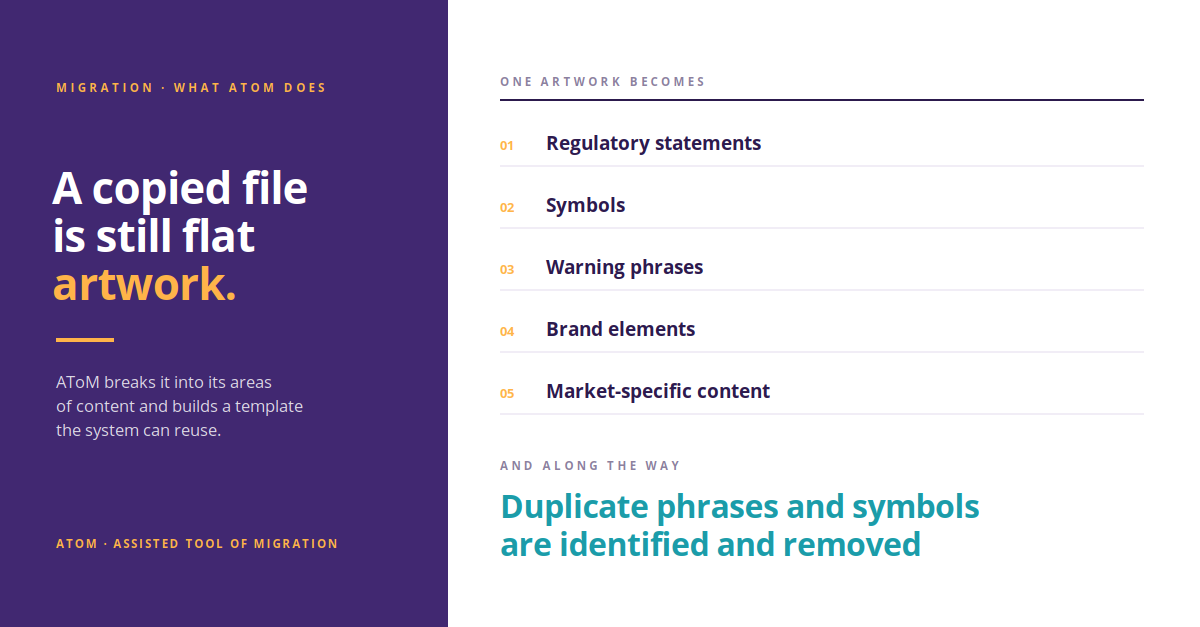
Ed Briggs, Product Requirements Analyst at Kallik, describes the process from the inside: "We'll take your existing artworks and labels and we will migrate them into the Veraciti system. One of our migration users will drop this file into AToM. And what AToM will do is it'll start breaking down the existing artwork into its areas of content, and it will create a template based on the artwork supplied."

That distinction matters. A copied file is still a flat piece of artwork. A structured template is a set of components – regulatory statements, symbols, warning phrases, brand elements, market-specific content – that the system can recognize, reuse, and control. AToM extracts the content, identifies and removes duplicate phrases and symbols along the way, and builds reusable templates with regulatory and brand logic already embedded.

You come out of migration with a clean, structured, deduplicated label library rather than a digital filing cabinet full of the same mess you had before. And the part customers tend to find most interesting is that AToM isn't static – every correction a migration user makes feeds back into the model.

"It has a machine learning process," Ed explains, "so the more artworks you feed into the system, all of the data that migration users are putting in will build a greater machine learning. So in the future, the more artworks dropped into the file, the greater accuracy AToM will have when migrating artworks and labels into the Veraciti system."

In practice that means the back end of a large migration runs faster and more accurately than the front end. For enterprises with sprawling portfolios across multiple regions and product families – exactly the organizations for whom manual migration is most punishing – that curve is the whole point.

Faster


What it Looks Like at Scale


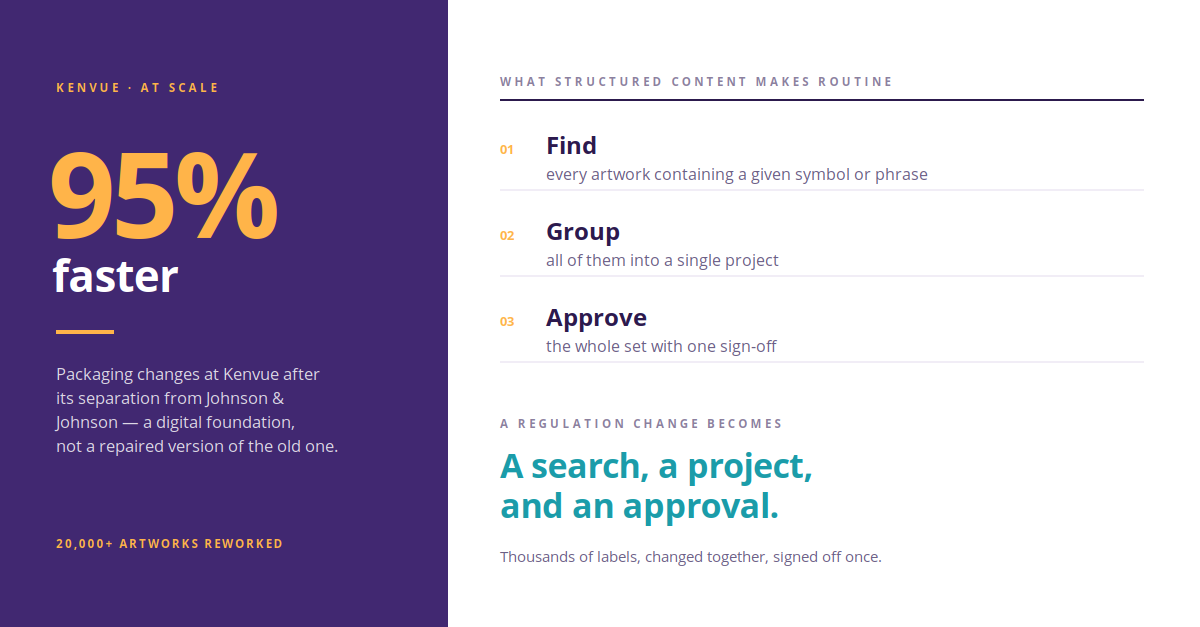
When Kenvue separated from Johnson & Johnson, it had to rework more than 20,000 artworks across a global brand portfolio. Working with Kallik and AToM, Kenvue removed the fragmentation across its label estate and cut its rework cycles, ending up with a digital foundation rather than a repaired version of the old one. Packaging changes now run 95% faster.
That number isn't really a migration statistic. It's what becomes possible once content is structured.


The Payoff Comes After Go-Live

Structured content is what turns a regulatory change from a project into a task. Once your labels are templates rather than files, Veraciti's Where Used feature lets you find every artwork containing a given symbol or phrase, pull them into a single project, update them together, and sign the whole set off at once. As Ed puts it, "this could be thousands of labels you could be changing for a regulation change with ease with a single sign-off, rather than having to go into each of these and manually adjusting them."

That capability only exists because AToM did the structural work up front. Migrate badly and every future regulation change is a manual sweep. Migrate properly and it's a search, a project, and an approval.


What This Actually Buys You

Shorter onboarding, so your investment starts returning sooner. Fewer errors introduced at the exact moment nobody is watching for them. A deduplicated content library instead of an inherited backlog. And a label estate that's ready for whatever the next regulation asks of it, rather than one that needs rebuilding first.

If the size of your archive is the reason you haven't moved yet, that's the specific problem AToM was built to solve. Book a demo and we'll show you what AToM does with your own artwork. Speak to our labeling and artwork experts by filling in a form here, or book a demo here.

Read our free guide on getting AI-ready

Learn how Kallik works<

FAQs about label artwork migration

What is AToM? 

AToM, or Assisted Tool of Migration, is the AI tool Kallik uses to bring existing labels and artwork into the Veraciti™ platform. Rather than copying files across, it reads each artwork, breaks it down into its areas of content, and builds a structured, reusable template from what it finds — identifying and removing duplicate phrases and symbols along the way.

Why is manual label artwork migration a compliance risk? 

Manual migration introduces variation at the exact point where nobody is checking for it. Values get retyped from legacy labels, inconsistent data fields get resolved by judgment call, and missing design files get recreated by eye. Repeated across hundreds of artworks, this seeds inconsistency into a library that is supposed to serve as a single source of truth — and because migration is usually treated as an IT project rather than a regulatory one, those errors often go unreviewed.

How does AToM turn existing artwork into reusable templates? 

A migration user drops the existing artwork file into AToM, which breaks it down into its areas of content and creates a template based on the artwork supplied. The distinction matters: a copied file remains a flat piece of artwork, while a structured template is a set of recognized components — regulatory statements, symbols, warning phrases, brand elements, and market-specific content — that the system can reuse and control.

Does AToM become more accurate over time? 

Yes. AToM uses a machine learning process, so every correction a migration user makes feeds back into the model. In practice this means the later stages of a large migration run faster and more accurately than the early ones — which matters most for enterprises with sprawling portfolios across multiple regions and product families.

Can AToM handle large label portfolios? 

Yes. When Kenvue separated from Johnson & Johnson, it had to rework more than 20,000 artworks across a global brand portfolio. Working with Kallik and AToM, Kenvue removed the fragmentation across its label estate and cut its rework cycles, ending up with a digital foundation rather than a repaired version of the old one. Packaging changes now run 95% faster.

What is the Where Used feature in Veraciti? 

Where Used identifies every artwork containing a given symbol or phrase, so a single regulatory change can be applied across all affected labels at once rather than label by label. Affected artworks are pulled into one project, updated together, and signed off in a single approval. The feature depends on content having been structured during migration, because flat artwork files cannot be queried this way.

What Are the Most Common Packaging Challenges in Mergers and Acquisitions?

What Are the Most Common Packaging Challenges in Mergers and Acquisitions?
Author Name
Kallik Role 1
Content Manager

The day you put your own logo on an acquired product, you become legally responsible for packaging you have almost certainly never seen the paperwork for. This does not come up in the deal room. It comes up in week three, when someone asks where the technical file for a particular carton is and the answer turns out to be a converter whose contract ended at close.

The most common packaging challenges in mergers and acquisitions are inherited compliance liability, approved artwork held by third parties, duplicate pack specifications, harmonizing regulatory copy across two portfolios, transferring extended producer responsibility registrations, and consolidating print suppliers. The unfortunate part is, almost all of them surface after close, when the integration clock is already running – but the good news is, there are ways to get ahead.


Who is Responsible For Packaging Compliance After an Acquisition?


Under the PPWR, the practical test for who counts as the manufacturer is whose brand appears on the packaging. If it is yours, the obligation to sign the Declaration of Conformity and hold the supporting technical documentation is yours, and you are the party auditable by market authorities. That responsibility stays with you even where a supplier or converter carried out the conformity assessment and prepared the file.

This matters at the exact moment an acquisition becomes visible on shelf. The day you rebrand an acquired product, you become the manufacturer of its packaging for PPWR purposes and inherit the evidence burden for it – every substance test result, recycled content claim, and material breakdown behind the declaration.

Most packaging diligence checklists were written before August 2026 and ask about volumes, formats, and supplier contracts. Very few ask to see the technical documentation. If it does not exist, or exists only in fragments across the seller's supply chain, you find out after you own it.


Where is Approved Packaging Artwork Actually Stored?


In most regulated manufacturers, print-ready artwork sits with design agencies, repro houses, and printers, and the acquired business holds reference PDFs rather than editable source files.

The contracts holding those relationships together frequently terminate at close. So the practical position on day one is that you own a SKU list, a set of flat PDFs, and no working files – while the people who can produce a corrected pack are no longer engaged. Establishing where every approved asset physically lives, and who has the right to release it, is worth doing during diligence rather than during your first regulatory change.


What Happens to Duplicate SKUs and Pack Specifications?


Portfolio rationalization gets treated as a commercial decision, but it is a data problem first. After close you hold two pack format libraries, two sets of dielines, two substrate specification systems, and two symbol libraries – and the two sides describe the same physical pack in incompatible terms.

You cannot rationalize what you cannot compare. Before anyone can decide which of two near-identical cartons survives, someone has to establish that they are near-identical, which means normalizing two specification vocabularies into one. That work is unglamorous, sits on the critical path for every synergy target attached to packaging, and is almost never scoped.


How Do You Harmonize Regulatory Copy Across Two Portfolios?


Harmonization is usually framed as process and culture alignment. In packaging it is narrower and considerably more expensive: two companies phrase the same warning differently, hold different translation sets, use different symbol conventions, and make subtly different claims about equivalent products.

Someone has to decide which version wins, per phrase, per market. That is a regulatory decision, repeated at scale, and it needs regulatory affairs sign-off rather than design sign-off. Teams that treat it as a branding exercise discover the difference at the first audit.


Do EPR Registrations Transfer When a Brand Changes Hands?


Extended producer responsibility registrations are held by a registered producer entity in each member state, not by the brand. A change of ownership generally requires action in every market where the packaging is placed, rather than transferring automatically with the asset.

The gap between close and completed re-registration is the exposure. Product continues moving; the obligation to report and pay against it has to sit with somebody, and transition service agreements do not always say clearly which somebody.


What Changes in a Divestiture or Carve-Out?


Everything above, run in reverse and under a harder deadline. You are stripping your identity off packs you no longer own while assembling artwork packages for a buyer, against a transition services clock set during negotiation rather than by anyone who has done a packaging migration.

Divestitures also expose asset custody faster than acquisitions do. You cannot hand over what you cannot locate, and the discovery that a printer holds your only editable file for a divested brand tends to arrive late.


Where the Obligations Sit


Obligation

Before close

After close

PPWR Declaration of Conformity

Seller, as brand owner

Buyer, from the point the pack carries its brand

Technical documentation

Held by seller, often assembled by suppliers

Buyer must hold and be able to produce it

EPR registration and reporting

Seller's registered entity, per member state

Requires re-registration in each market

Approved artwork source files

Frequently with agencies or printers

Unchanged unless custody is transferred deliberately

Regulatory copy decisions

Independent per company

Must be reconciled phrase by phrase


Getting ahead of it


The pattern across all six is the same: packaging obligations are attached to data that no one has consolidated, and the deal timetable assumes that consolidation is quick. It is quick only where a single source of truth already exists.

Kallik's Veraciti™ platform is built for exactly this position – bringing artwork, specifications, and regulatory content into one governed system so that a change of ownership becomes a data operation rather than a rebuild. If you are heading into a transaction and want to talk through what integration would actually involve, get in touch.
 

FAQs: packaging in mergers and acquisitions

Does a Declaration of Conformity transfer with an acquired brand?

Not automatically in any useful sense. Once the packaging carries the acquiring company's brand, that company is treated as the manufacturer and needs its own declaration supported by technical documentation it holds. Obtaining the seller's evidence file during diligence is what makes that possible.

How long does packaging artwork migration take after a merger?

It depends almost entirely on where the source files sit and how consistently the acquired portfolio was specified. Migrations from a single governed system take weeks. Migrations from mixed agency and printer custody take months, and the variable is asset discovery rather than production.

What should packaging diligence cover that financial diligence does not?

Custody of editable artwork files, PPWR technical documentation and declarations, EPR registrations by member state, printer and agency contract termination terms, and the specification vocabulary used across the portfolio.

Is PPWR fully in force?

No. Obligations covering declarations of conformity, technical documentation, manufacturer identification and substance restrictions apply from 12 August 2026. Requirements including harmonized labeling, recyclability grades, packaging minimisation and deposit return systems arrive in later phases through 2030.

FDA Uncertainty and Cosmetics Labeling: How to Prepare Without a Deadline

FDA Uncertainty and Cosmetics Labeling: How to Prepare Without a Deadline
Author Name
Kallik Role 1
Content Manager
Blog Related to Regulation Page

If the FDA published the fragrance allergen rule tomorrow morning, how long would it take you to update every affected label? Not to work out which ones are affected. To actually change them, route them for approval, and get them to print.

Most people we put that question to can't answer it, because the question has simply never needed answering before, because regulators used to arrive with a date attached, and a date lets you build a plan around it.

Right now though? There's no date and there's barely an agency to ask either, so you’d be forgiven for feeling a little stressed and uncertain if you work in the cosmetics space right now.


What FDA Leadership Changes Mean for Cosmetics Brands


We speak to regulatory and packaging teams across the sector regularly, and the tone has shifted noticeably this year. People aren't confused about what's coming – they've read the same information as everyone else. Instead, they’re stuck waiting to see when that set of obligations will land eventually, on a schedule set by an agency in the middle of its own upheaval, hitting product ranges that in some cases run to thousands of SKUs.

We’ve heard it described as packing for a trip without knowing the destination or the departure date. You know you'll need to move fast, but you just can't do anything with that knowledge yet.


Why Delayed Regulations Increase Labeling Workload and Risk


Delay often feels like relief, like the pressure is off and you can take a step back. In actual fact, it’s the complete opposite.

Every month a rule sits unpublished, the eventual compliance window doesn't get longer. It gets denser. The work doesn't evaporate during the wait. Instead it accumulates, then arrives in a single lump, competing with the launches, seasonal packs, and market variants already sitting in your queue.

So the thing worth focusing on isn't the date. It's the lag: the number of days between a rule landing and your last affected label being approved and out the door.

That number belongs entirely to you. It's determined by how your labeling operation is built, and unlike the FDA's timetable, you could change it – and it’s probably quicker and easier than you think!


What Slows Down Cosmetics Label and Artwork Updates


The thing slowing down cosmetic label and artwork updates is rarely the change itself, but rather finding the change and making it accurately. When label content lives inside artwork files, every ingredient statement is a separate object. Update one allergen declaration across 800 SKUs and you're opening 800 files. Answering "which of our products contain this?" becomes a manual audit rather than a search.

Then there's sign-off. Approval routed through email and shared drives is slow at normal volumes and falls over at high ones. Version control gets fuzzy, people chase, and eventually someone approves the wrong proof. Structured artwork approval fixes this by making the route itself the record, so the audit trail builds as people work rather than being reconstructed from inboxes six months later.

Cloud-based label and artwork systems matter more here than they might sound like they should. Regulatory work is distributed now. A supplier in one country, a reviewer in another, a print partner somewhere else again. Everyone needs the current version, not a current version.

Put those pieces together and the shape of the problem changes. Label content becomes reusable components rather than text welded into a file. One approved change flows through to every product that uses it. Where-used search returns the affected list in seconds instead of weeks. A regulatory update stops being an event and becomes a task.


Is Labeling Software Worth the Investment?


We get it, managing emails and spreadsheets is practically free, whereas investing in software can be costly. It’s true, enterprise labeling software is a real investment and the payback doesn’t happen immediately.

But look at what the alternative really costs. We’re talking about the hours spent hunting SKUs, the rework when an outdated ingredient list reaches print, and the launches held up because artwork is stuck behind a compliance scramble. Nevermind the reputational, monetary and even life-threatening consequences of a recall! Reality is, those costs are being paid by your business right now, just spread thinly enough that nobody puts them on a line item. And the volume of regulatory change heading toward this sector isn't going to make them smaller.


Moving Legacy Labels Into a New System Without the Pain


If cost isn’t your objection to making the move, we can almost bet the migration process is what’s holding you back. Nobody wants to hand over a decade of legacy artwork and hope it comes out the other side intact.

If that's the thing holding you back, it's worth knowing our platform uses a migration tool called AToM to handle exactly this. It reads your existing labels and artwork and converts them into structured, reusable content, which turns onboarding from a multi-year manual slog into something considerably shorter and a great deal less painful.


Preparing for FDA Changes Without a Deadline


Here's the short version of all this. The uncertainty is real, and it isn't going away soon. But the reality is, setting the regulation date was never the part you controlled. What you control is what happens the day after it's announced. Whether that day means a room full of people opening artwork files one at a time, or a where-used search, one approved change, and a normal week.

That difference isn't down to how well your team knows the regulations. It's down to whether your label content is structured, your approvals are traceable, and your system is accessible to everyone who needs it. Get those three things right and regulatory change stops being an emergency.

The teams that will handle the next FDA announcement calmly are already making that change now, while there's no deadline forcing them to. That's the advantage of the current lull. You can't control when the FDA moves, but you can control whether that day is a scramble or just a Tuesday.

If you’re ready to make the move and transform your label and artwork management for the better, speak to one of our experts. Call us on +44 (0) 1827 318100, email enquiries@kallik.com, or fill in a form here.

Get clued up on MoCRA requirements

Learn how Kallik works

Frequently asked questions

What is happening with FDA leadership?

Commissioner Marty Makary resigned in May 2026, prompting a series of senior departures across the agency. Kyle Diamantas has been serving as acting commissioner since. In August 2026, Dr. Heidi Overton was nominated as the next commissioner, subject to Senate confirmation. Separately, the FDA's Office of Cosmetics and Colors moved out of the Center for Food Safety and Applied Nutrition into the Office of the Chief Scientist in 2024.

Which FDA cosmetics rules are still pending?

Final rules on Good Manufacturing Practice, fragrance allergen disclosure, and standardized talc testing methods are all still outstanding, along with the FDA's assessment of PFAS in cosmetics. Fragrance allergen disclosure is the one most likely to require widespread label changes, since it is expected to affect ingredient statements across large portions of a product range.

Do FDA delays give cosmetics companies more time to prepare?

Not in practice. A delayed rule does not extend the compliance window once it is published, it simply concentrates the work into a shorter period. The label changes still have to happen, but they arrive as a single block of work competing with launches, seasonal packs, and market variants already in the queue.

How long does it take to update labels across thousands of SKUs?

It depends entirely on how label content is stored. Where content sits inside individual artwork files, each affected SKU has to be identified and edited separately, which can take weeks or months. Where content is managed as reusable components, a where-used search identifies affected products in seconds and a single approved change flows through to all of them.

How can cosmetics companies prepare for FDA rules that have no deadline?

Focus on the lag rather than the date. That means the number of days between a rule being published and every affected label being updated, approved, and sent to print. Structuring label content, making approval routes traceable, and moving to a cloud-based system all reduce that number, and none of them require knowing when the rule lands.

Preventing Packaging Artwork Failures in 2026

Preventing Packaging Artwork Failures in 2026
Author Name
Kallik Role 1
Content Manager

Packaging artwork failures cost regulated manufacturers far more than reprinting labels. A single labeling error in pharma, medical devices, or chemicals can trigger recalls, regulatory fines, and serious patient safety risks. According to a 2026 Fonteum analysis of FDA enforcement data, labeling and packaging issues are among the top reasons for device recalls. Kallik helps regulated manufacturers prevent these failures through packaging artwork management built for compliance-first workflows.


Why Packaging Artwork Failures Happen in Regulated Industries


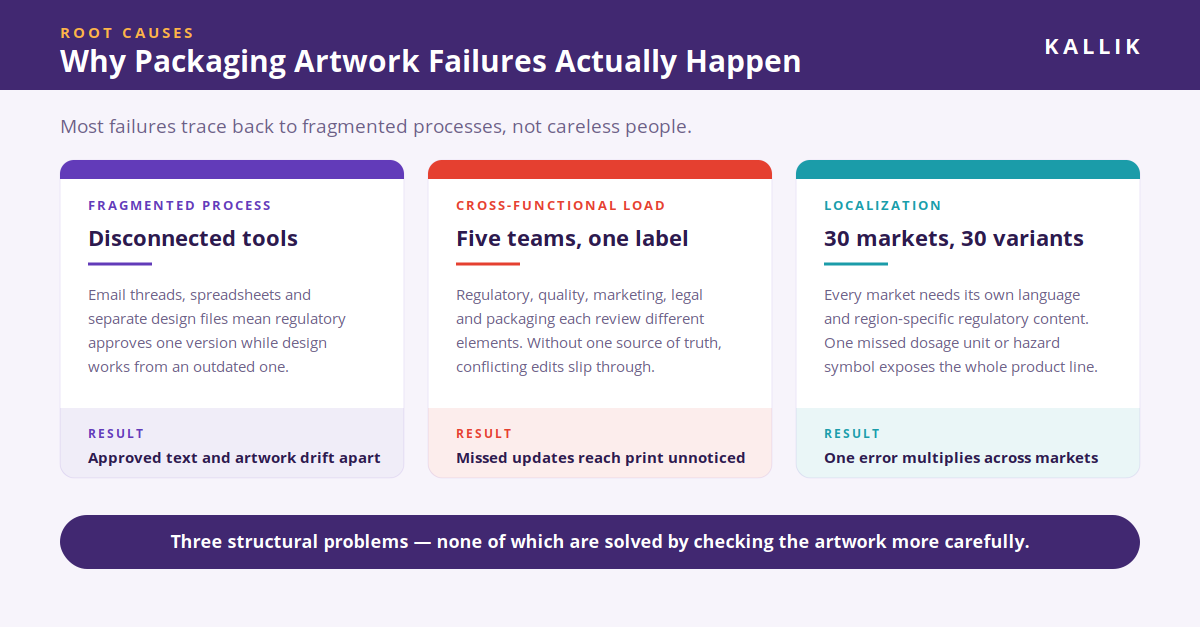
Most artwork failures trace back to fragmented processes, not careless people. When teams rely on email threads, spreadsheets, and disconnected tools to manage label content, version confusion becomes inevitable. A regulatory affairs team might approve one version of a label text while the design team works from an outdated file.

Cross-functional complexity makes things worse. Artwork approvals in regulated manufacturing typically involve regulatory affairs, quality assurance, marketing, legal, and packaging engineering. Each stakeholder reviews different elements, and without a single source of truth, conflicting edits and missed updates slip through.

Translation and localization add another layer of exposure. A product sold across 30 markets needs 30 language-specific label variants, each with region-specific regulatory content. One missed dosage unit change or an incorrect hazard symbol can result in non-compliance across an entire product line.
 

Artwork graphic root causes


The Real Cost of Getting Artwork Wrong


The consequences of artwork failures extend well beyond the cost of reprinting. In the FDA's enforcement database, labeling and packaging errors rank as a leading reason for device recalls. For drug products, recall-related disruptions can reduce after-tax profits significantly when products ship late.

Regulatory penalties add up quickly. Non-compliance with standards like EU CLP or FDA 21 CFR Part 211 can result in fines, warning letters, and market withdrawal. Then there are the indirect costs: lost retailer contracts, supply chain disruptions, and the slow erosion of brand trust that follows a public recall.


Where Artwork Workflows Break Down


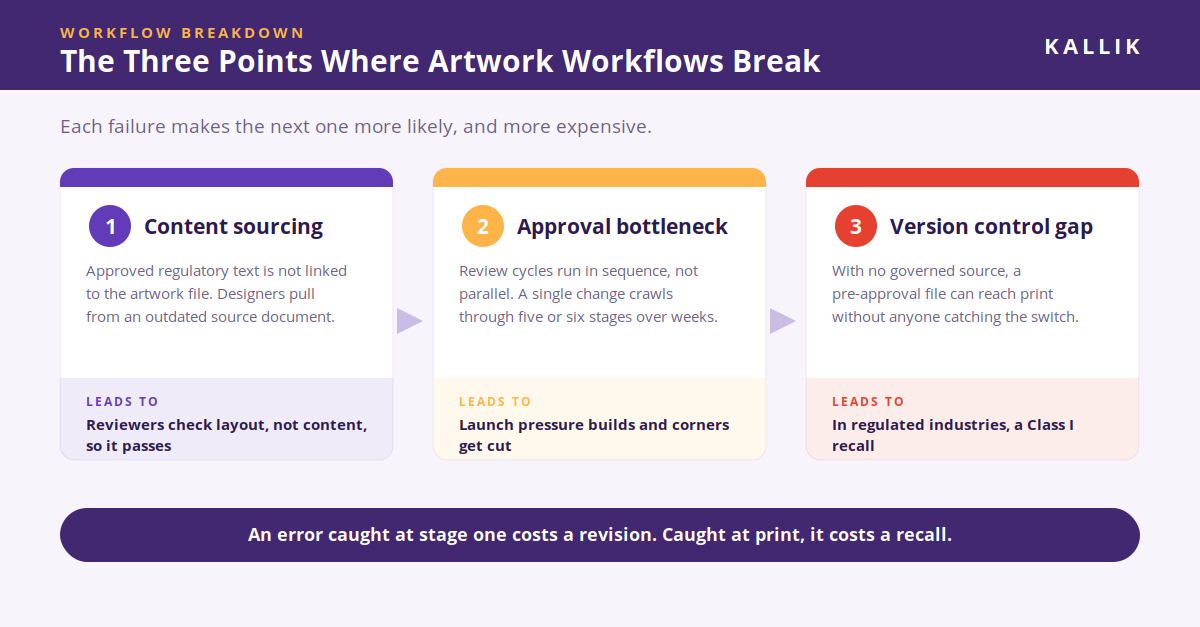
Three breakdown points appear repeatedly in regulated artwork workflows. First, content sourcing errors occur when approved regulatory text is not properly linked to the artwork file. Designers may pull from an outdated source document, introducing discrepancies that reviewers miss because they are checking layout, not content accuracy.

Second, approval bottlenecks form when review cycles run in sequence rather than in parallel. In some organizations, a single label change can take weeks to move through five or six approval stages. This delays product launches and increases the pressure to cut corners late in the process.

Third, version control gaps create the conditions for the most dangerous errors. Without governed artwork management, teams may accidentally release a pre-approval version to print. In regulated industries, that kind of failure can trigger a Class I recall.
 

Artwork graphic workflow breakdown


How to Prevent Artwork Failures Before They Start


Prevention starts with centralizing your artwork and label content in a single governed platform. When all regulated text, symbols, translations, and design files live in one controlled environment, you eliminate the version confusion that causes most errors. Kallik's Veraciti platform gives you this kind of centralized control, connecting label content directly to artwork workflows so that every change is traceable.

Structured approval workflows are equally important. Configurable, role-based review paths ensure the right people review the right elements at the right stage. Parallel review capabilities reduce cycle times without sacrificing rigor. And built-in audit trails capture every action, so you can demonstrate compliance during inspections without scrambling for documentation.

Automated change propagation closes the remaining gap. When a regulatory update affects a specific phrase or symbol, an integrated platform can identify every label and artwork file that uses that content and flag them for review. This kind of impact analysis is what separates reactive error correction from proactive failure prevention.


Building a Failure-Proof Artwork Operation


Technology alone does not solve the problem, unfortunately. You also will need clear process governance. Define ownership for each stage of the artwork lifecycle: who initiates a change request, who reviews regulatory content, who gives final quality approval, and who authorizes print release.

Integrate your labeling platform with upstream systems like ERP, PLM, and regulatory information management tools. When product data flows automatically into your labeling system, you remove the copy-paste operations that introduce human error at scale.

Finally, treat your artwork operation as a strategic function, not an administrative task. The organizations that invest in structured, governed artwork workflows are the ones that bring compliant products to market faster, avoid costly recalls, and maintain the regulatory confidence their customers and patients depend on.


How to Protect Your Artwork Process from Failure


Packaging artwork failures in regulated manufacturing are preventable. They start with fragmented processes and disconnected tools, and they end with recalls, fines, and lost time. By centralizing content, structuring approvals, and automating change propagation, you can build an artwork operation that delivers compliant labeling every time.

Ready to change your label and artwork management process for the better and prevent failures for good? Speak to one of our experts by emailing enquiries@kallik.com, calling +44 (0) 1827 318100 or filling in a form.
 

Packaging artwork management: FAQs

What are the three main breakdown points in a regulated artwork workflow?

Regulated artwork workflows typically break down in three places: content sourcing, approvals, and version control. Content sourcing fails when approved regulatory text is not linked to the artwork file, so designers pull from an outdated source document. Approvals fail when review cycles run sequentially through five or six stages instead of in parallel. Version control fails when there is no governed release gate, allowing a pre-approval file to reach print.

Why do reviewers miss content errors in packaging artwork?

Reviewers miss content errors because they are checking layout, not content accuracy. When approved regulatory text is not systematically linked to the artwork file, a discrepancy introduced at the design stage — an old dosage unit, a superseded warning phrase — passes visual review because nothing prompts the reviewer to verify it against the source. Linking label content directly to artwork removes the assumption that someone else has already checked it.

How does multi-market localization increase labeling compliance risk?

Localization multiplies risk because every market variant carries its own regulatory content, not just a translated version of the same content. A product sold across 30 markets needs 30 language-specific label variants, each with region-specific requirements. A single missed dosage unit change or an incorrect hazard pictogram can put an entire product line out of compliance across every market that shares that content.

What is automated change propagation in label and artwork management?

Automated change propagation is the ability to identify every label and artwork file affected by a change to a specific phrase, symbol, or data element, and flag them all for review. When a regulator updates a required hazard statement, for example, the platform performs impact analysis across the full artwork library instead of requiring teams to search manually. This is what shifts an operation from reactive error correction to proactive prevention.

Can artwork approvals be made faster without weakening compliance?

Yes — by running reviews in parallel rather than in sequence. Sequential routing through regulatory affairs, quality assurance, marketing, legal, and packaging engineering can stretch a single label change into weeks, which creates pressure to cut corners late in the cycle. Configurable, role-based workflows let each function review only the elements it owns, at the same time, with audit trails capturing every action.

Which upstream systems should a labeling platform integrate with?

A labeling platform should integrate with ERP, PLM, and regulatory information management (RIM) systems. When product data flows automatically from these sources into the labeling environment, the manual copy-paste operations that introduce human error at scale are eliminated. Integration also keeps label content synchronized when a product specification or regulatory submission changes upstream.

AI Won't Fix Bad Data: Why Regulated Industries Are Sitting on a Compliance Timebomb

AI Won't Fix Bad Data: Why Regulated Industries Are Sitting on a Compliance Timebomb
Author Name
Kallik Role 1
Content Manager

There's a lot of noise right now about what AI can do for labelling and artwork management. Less is being said about what it can't do: turn messy, fragmented data into something trustworthy.

That's the warning Kallik is putting out to regulated industries this month. As the global leader in enterprise labelling and artwork management software, working with brands including Kenvue, Cardinal Health and Procter & Gamble, we're seeing a pattern that worries us: companies under pressure are adopting AI tools before they've sorted out the "operational basics." And in pharma, med device, and other highly regulated sectors, that gamble carries real consequences.


The squeeze that's driving the rush


It's not hard to see why teams are reaching for AI. Regulatory overhauls across the US and Europe are approaching fast, skills shortages are leaving already-stretched teams struggling to manage increasingly complex product lifecycles, and there's constant pressure to protect margins while getting products to market quickly.

Faced with all that, automation looks like the obvious answer. AI tools promise to handle intricate labelling updates, multi-language translations and shifting regulations at a pace manual, under-resourced teams simply can't match. The problem isn't the ambition. It's what happens when that ambition meets poor foundations.
 

The AI compliance timebomb in labeling and packaging


Panic buying meets fragmented data


We're calling it panic buying for a reason: businesses are deploying AI checking mechanisms on top of siloed, inconsistent data, and that combination opens the door to serious compliance errors.

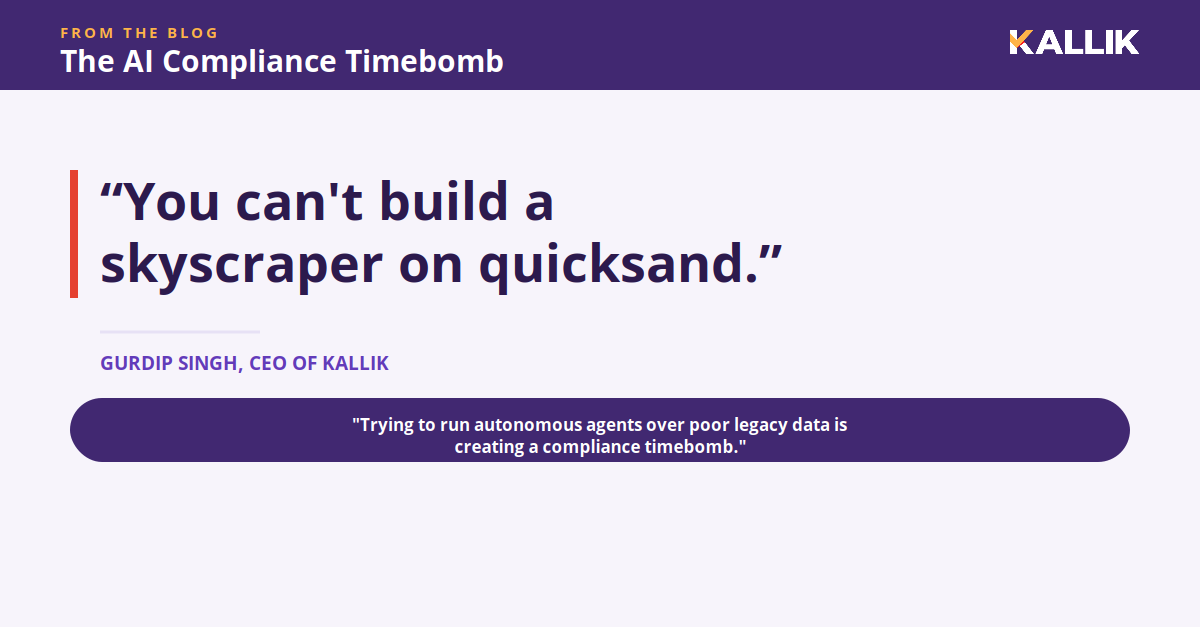
Gurdip Singh, CEO of Kallik, puts it bluntly: "There's a massive amount of noise in the market right now about what AI can do, but trying to run autonomous agents over poor legacy data is creating a compliance timebomb. One that pharma and med device manufacturers will absolutely want to avoid."

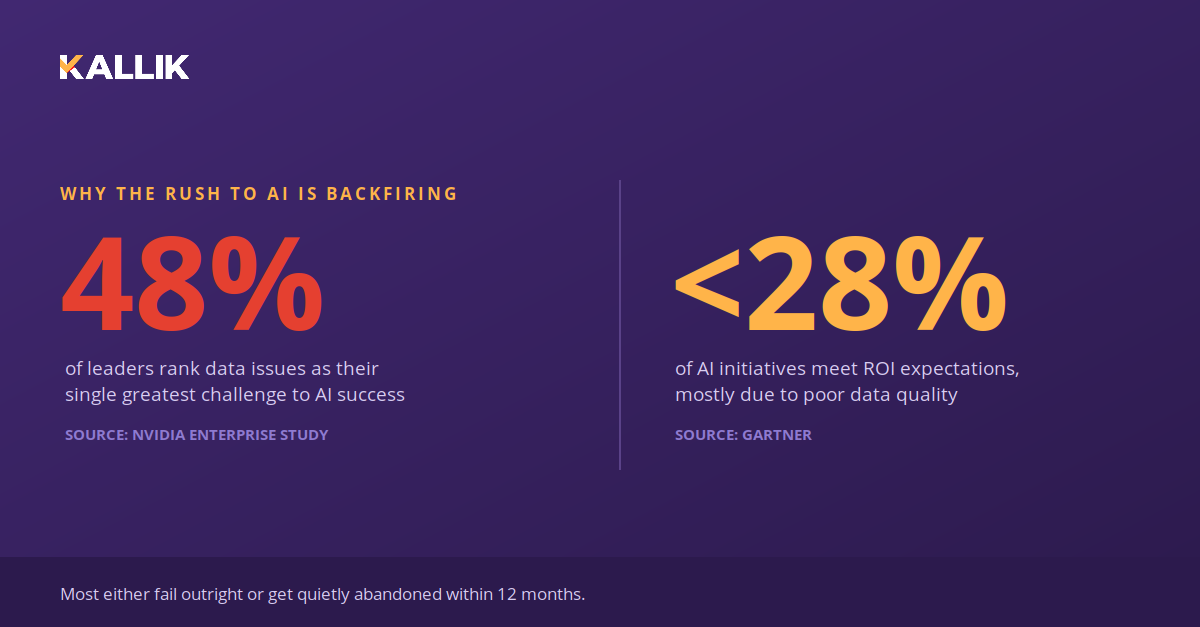
It's not an isolated concern either. A recent NVIDIA enterprise study found that 48 percent of leaders rank data-related issues as their single greatest challenge to successful AI implementation. As Gurdip puts it: "You can't build a skyscraper on quicksand."

48% of leaders rank data issues as their single greatest challenge to AI success


What actually goes wrong


When an AI tool queries unchecked, fragmented data, it starts connecting the wrong dots. That might mean silently dropping a European date format into a US template, or subtly altering a mandatory font.

In a low-stakes environment, that's an annoyance. In pharma or med device labelling, it's a different story entirely. A tiny hallucination like that can break the entire chain, triggering compliance failures, reputational damage and multi-million-pound product recalls, each one putting patients at risk.

This isn't a fringe issue, either. A global Gartner study found that fewer than 28 percent of AI initiatives meet ROI expectations, largely because of poor data quality. Most either fail outright or get quietly abandoned within 12 months.


Fixing the foundation first


This is why Kallik built its approach around data before automation, not the other way round. Our innovative migration tool, AToM (Assisted Tool of Migration), is a pure AI-driven engine that intelligently reads and extracts data from legacy formats at the onboarding stage, eliminating the manual input errors and duplicates that feed AI hallucinations in the first place.

That clean, accurate data then feeds directly into Veraciti™, our cloud-native single source of truth. Veraciti™ atomises content into pre-approved, version-controlled building blocks within a central asset and phrase manager. Because the data layer is fully structured, Veraciti™ stays entirely vendor-agnostic, so enterprises can securely plug and play any corporate LLM or external AI tool into a validated environment via secure APIs.

"We still continue to see businesses storing their data in spreadsheets or on old, outdated software, either updated by several different people across various departments, or by no one at all," Gurdip says. "So if you don't know what 'language' your data speaks, or whether it's the very latest version of information, your AI certainly won't."
 

Don't adopt AI on top of a labeling mess


The stress test regulated industries can't afford to fail


Gurdip concludes: "This new wave of AI adoption in the industry feels like a new kind of stress test. Advanced automation can easily handle massive data migrations and instant multi-language updates at lightning speed, but it requires an absolute single source of truth to pull from. Without that ironclad data, you are effectively letting an autonomous system fly blind into a regulatory storm."

For regulated industries, the message isn't "don't adopt AI." It's "don't adopt it on top of a mess." Get the data foundation right, and automation becomes a genuine advantage rather than a hidden liability.

We've spent years inside exactly this problem with global, regulated manufacturers. If your team has ever quietly wondered whether "organized" and "audit-ready" are actually the same thing, this is worth twenty minutes of your time before you commit to an AI roadmap, not after. 

Find Out If You're Actually AI-Ready →

The Messy Middle: Why Enterprise Labeling Teams Feel More Organised Than They Really Are

The Messy Middle: Why Enterprise Labeling Teams Feel More Organised Than They Really Are
Author Name
Kallik Role 1
Content Manager

Ask most labeling teams how organized they are, and you'll get a confident answer. There's a system of record, an approval workflow, a folder structure that makes sense, at least to the people who built it. On paper, it looks like a tight operation.

Then ask a different question. Where does a product's approved copy actually live the moment someone starts a change request? Who can say, without checking three places, whether a translation was reviewed by the right person in the right market? What happens to a label variant when a regulation shifts in one country but not the other nine it's sold in?


That's the messy middle. Not the start of the process, where a request comes in and everyone knows the drill. Not the end, where a final asset gets stamped and shipped. The middle: the stretch where data gets copied between spreadsheets, approvals happen over email threads that fork into three versions, and "who owns this" quietly becomes "whoever noticed it first."

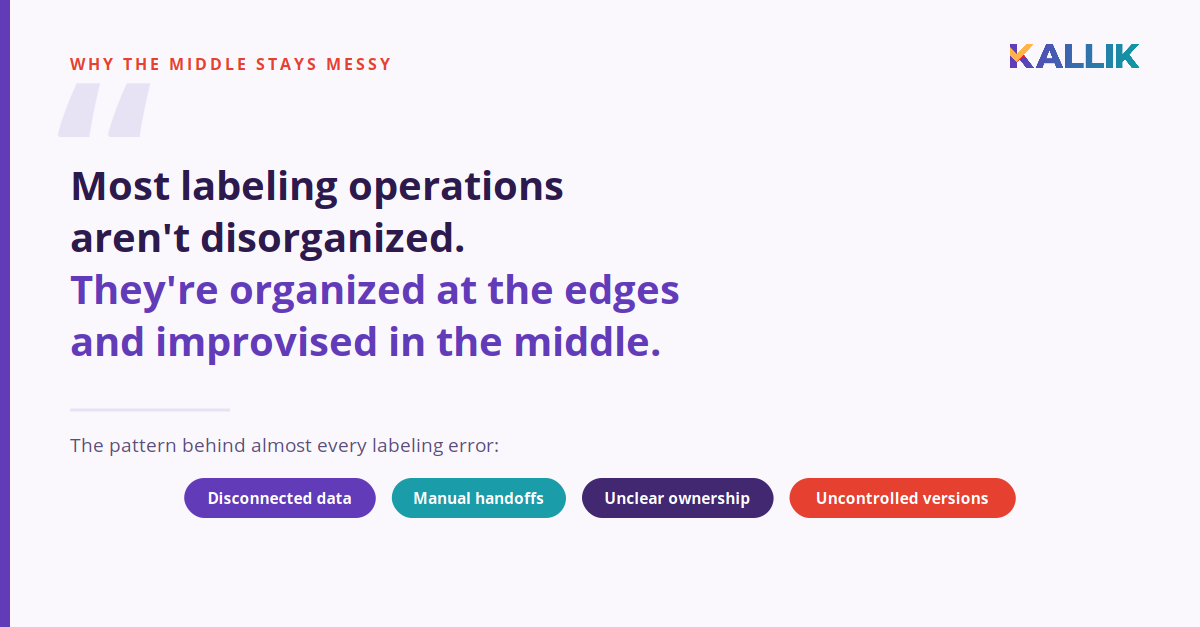
Most labeling operations aren't disorganized. They're organized at the edges and improvised in the middle. And that gap is exactly what's standing between them and genuine AI readiness.

most labeling operations aren&apos;t disorganized, they&apos;re organized at the edges and improvised in the middle


Why the middle stays messy even in mature teams

This isn't a failure of effort. It's a structural side effect of how labeling operations grow. A company starts with one product line and one market, and a shared drive is genuinely fine. Then it's ten markets, then fifty, then a few thousand SKUs, each with its own regulatory quirks, language requirements, and approval chain. Nobody sits down one day and designs for that scale. It arrives gradually, and the tools that worked at the start get patched, not replaced.

The result is a labeling operation that's a patchwork of genuinely good systems stitched together with manual work. A proper label management platform for the master content. A separate tool for artwork. Email for approvals that don't fit either. A spreadsheet somewhere that's become load-bearing, even though nobody would admit it in a steering committee.

Regulators have seen the consequences of this for years. Mislabeling and packaging errors are a routine, repeatable cause of product recalls, not a rare edge case, and the pattern behind them is almost always the same: disconnected data, a manual handoff that should have been automatic, unclear ownership at the point of change, or a version that slipped through because nobody could see it had already been superseded. None of that shows up on an org chart. It shows up in the middle.

Why AI makes this worse before it makes it better

Here's the part that catches most teams off guard. Artificial intelligence and automation don't fix a messy middle – they amplify it.

Think of it like handing a very fast, very literal assistant the keys to your current process. If your approved content, your translations, and your regulatory rules already live in one governed place, that assistant becomes genuinely useful: it can flag the label variant affected by a rule change, draft the update, and route it to the right reviewer, all before a human would have finished searching for the source file. If your approved content is scattered across drives, inboxes, and someone's "final_v3_ACTUAL" folder, that same assistant will happily automate the confusion. It will move faster, with more confidence, in exactly the wrong direction.

This is the uncomfortable truth behind most AI readiness conversations. The question was never "do we have access to AI tools." Most companies do, or will within a year. The real question is whether the foundation underneath them, the data, the ownership, the audit trail, can support automation without quietly multiplying the risk. Gartner's recent research into enterprise disruptors points at exactly this shift: domain-specific AI models and digital trust platforms are moving up the priority list, precisely because generic automation on top of ungoverned data creates more exposure, not less.

A useful way to picture it: a tidy desk doesn't tell you anything about the drawer underneath it. Plenty of labeling operations have a tidy desk – dashboards, KPIs, a clean-looking process map for the auditors. The drawer is where the real work happens, and it's rarely as tidy as the desk suggests.

What "AI-ready" actually looks like in a labeling operation

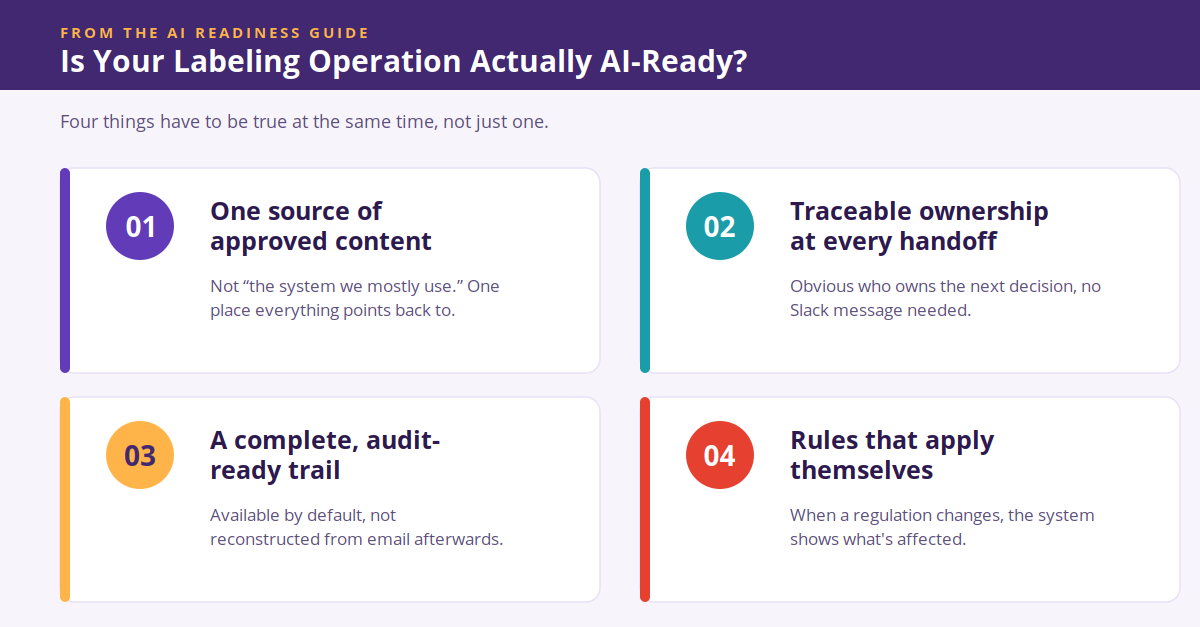
Genuine AI readiness in this world isn't about which tool you've licensed. It's about whether four things are true at the same time:

One source of approved content

Not "the system we mostly use." One place where the current, approved version of every piece of content lives, with everything else pointing back to it.

Traceable ownership at every handoff

When content moves from drafting to regulatory review to market approval, it should be obvious who owns the next decision, without a Slack message asking "does anyone know where this is at."

A complete, inspection-ready audit trail

Not reconstructed after the fact from email search. Available, by default, showing what changed, who approved it, and which markets and products it touched.

Rules that apply themselves

When a regulation changes for one market, the system should be able to show exactly which labels are affected, rather than relying on someone remembering to check.

Companies that get this right see the difference in very concrete terms. Diversey, for example, needed to control thousands of multilingual labels across more than fifty countries without adding another layer of manual oversight.

By bringing content, approvals, and artwork workflows into one governed system, the business now manages around 13,000 European artworks in a single place and has doubled artwork capacity across Eastern Europe without adding headcount. That's not a story about buying an AI tool, but rather a story about fixing the middle first, so that automation had something solid to build on.
 

Is your labeling operation actually AI-ready?


The honest self-check most teams haven't doneThe honest self-check

Here's the thing about the messy middle: it's genuinely hard to see from inside your own organization. You know your systems. You know the workarounds so well they stopped feeling like workarounds years ago. The gap between "we feel organized" and "we could survive an audit, a recall, or an AI rollout without finding a nasty surprise in the middle" isn't something a dashboard shows you.

That's the exact gap we built our AI Readiness Guide to close. It's a practical way to see where your labeling operation genuinely stands: what's solid, what's improvised, and what would break first if you tried to automate on top of it today. There's a short self-assessment too, so instead of guessing, you get a straight answer about where the real risk sits.

We've spent years inside exactly this problem with regulated manufacturers, which is honestly the only reason we could build something this specific. If your team has ever quietly wondered whether "organized" and "audit-ready" are actually the same thing, this is worth twenty minutes of your time before you commit to an AI roadmap, not after.

Find Out If You're Actually AI-Ready →

AI, ML, RPA, or automation? Why the difference matters more than the buzzword

AI, ML, RPA, or automation? Why the difference matters more than the buzzword
Author Name
Kallik Role 1
Content Manager

Ask ten people in a boardroom what "AI" means and you'll get ten different answers. Most of them will be confident. Most of them will also be wrong, or at least incomplete. And in an industry where a mislabeled product can mean a recall, a regulatory breach, or worse, "close enough" isn't a great place to be operating from.

Here's the thing nobody wants to say out loud: a huge amount of what gets marketed as "AI" right now is nothing of the sort. It's automation with better branding. Sometimes it's machine learning dressed up to sound more impressive than it is. And sometimes it's genuinely nothing at all beyond a logo on a slide deck and a line in a sales pitch. That's not a dig at the technology. It's a dig at how it's being sold.

The name-drop problem

Walk the exhibition floor at any regulatory or compliance conference and count how many times you hear "AI-powered" in the space of an hour. Now ask how many of those companies can tell you, in plain terms, what their AI actually does, why it's AI rather than something simpler, and what changes for the customer as a result. The silence is telling.

This matters because somewhere above most of the people reading this article, a board has decided AI is strategic. Which means somewhere below them, someone has been told to "go and use AI," and now has to work out what that actually means in practice.

JT, who's well versed in the nuances of legal, compliance, and regulatory affairs teams from his client engagement work here at Kallik, has a line about this that's stuck with us: "It's like being told to go and buy six cars. Okay, which ones? For what? A fleet of vans is not the same as six sports cars, but from the outside, 'buy six cars' sounds like one simple instruction. AI is the same. It's not one thing. It's a category, not a decision." 

So the board says "AI." Does that mean they've got a defined use case, solving a real problem for real customers? Or have they seen a competitor's PR machine in action and started worrying their own USP is looking thin? Often nobody's stopped to ask. And vendors who lean into that vagueness rather than resolving it aren't doing anyone any favours. They're helping a nervous procurement team tick a box marked "innovative" for the next board update, quietly hoping nobody asks what's underneath it.

So what's actually the difference?

Let's clear this up properly, because it's genuinely not complicated once someone explains it without an agenda.

Automation is rules doing what rules are told to do. If X happens, do Y. No learning, no judgment, no adaptation, just consistent, reliable execution of a process a human has already defined. Automation is often the least glamorous of the three and also, for a lot of regulated businesses, the one that delivers the fastest and most measurable return. Think: a label change automatically triggering the right approval route in every market it touches, without someone manually checking a spreadsheet to work out who needs to sign off in Brazil versus Germany.

Machine learning is where things start learning from data rather than following fixed rules. It spots patterns across large volumes of information and gets better, or at least different, as it sees more of it. This is powerful for things like flagging anomalies in artwork data or predicting where a compliance bottleneck is likely to occur based on historical patterns. It's not thinking, but rather pattern recognition at a scale humans can't match by hand.

Artificial intelligence is the broader, more ambitious category: systems designed to perform tasks that would typically require human judgment. This is where things like content generation, contextual decision support, and adaptive recommendations live. It's also the term that gets stretched the thinnest, because "AI" sounds better in a pitch deck than "if-then logic," even when if-then logic is what's actually running under the hood.

None of these is inherently better than the others. That's the part that gets lost. The right answer depends entirely on the problem you're trying to solve, and that's exactly where most conversations about "getting AI" go wrong before they've even started.

"People don't know the difference, and they don't know what they need"

This is the sentence JT comes back to more than any other when he talks about the conversations he has day to day: "Most people who come to us have already been told to 'do something with AI' before anyone's worked out what problem they're solving. They don't know the difference between AI, ML, and automation, and that's fine, that's not their job to know. But it means the first conversation we have usually isn't about technology at all. It's about working backwards from what's actually slowing them down."

That backwards approach matters more than it sounds. Because the honest answer to "what AI should we buy?" is very often: none of it, yet. What you need first is clarity on the problem. Then the right technology, whichever category it falls into, becomes obvious.

Choosing the tool for the job, not the job for the tool

This is where the industry-wide temptation to lead with AI becomes a genuine risk rather than just an irritating buzzword habit.

If a business rushes to implement an AI solution before understanding whether the underlying problem is actually a data quality issue, a process bottleneck, or a plain lack of automation, it ends up with an expensive, complicated answer to a question nobody asked properly.

The better sequence looks like this:

  1. Define the actual bottleneck. Not "we need AI," but "approvals for market-specific artwork take three weeks longer than they should, and nobody can see why."
  2. Work out what's causing it. Manual, repetitive steps that don't need human judgment? That's automation territory. Patterns across huge volumes of data that no person could reasonably track? That's machine learning. Genuine, complex decision support that needs contextual reasoning? Now you're talking AI.
  3. Match the technology to the problem, not the other way round.
    It's a less exciting process than announcing an AI initiative to the board. It's also the one that actually delivers something.

The part that doesn't get said enough

None of this is a case against AI. Used well, in the right place, for the right reason, it's genuinely transformative, particularly for regulated industries drowning in complexity across multiple markets, products, and approval chains. Automation and machine learning have quietly been doing serious heavy lifting in artwork and label management for years, long before "AI" became the word everyone reached for.

The problem has never been the technology. It's the habit of treating it as a single, interchangeable thing you can buy off a shelf to satisfy a board slide, rather than a set of very different tools, each suited to a very different job. Get that distinction right first, and the rest of the conversation gets a lot easier.

Where to go from here

Any AI is only as good as the data behind it. That's why Kallik's approach starts with the problem, not the tech: what's the scale of the issue, is your data sitting in silos that need connecting, and only then, is AI, ML, or automation actually the right answer? Layering AI over a spreadsheet or bolting it onto your PLM or ERP as a plug-in isn't a strategy, it's a hope. Our engineering team has spent years building AI, machine learning, and automation into our end-to-end, cloud-based software, Veraciti™, on foundations that are properly cemented first, and with compliance and data accuracy never an afterthought.

If you're trying to work out which of the three you actually need, that's a conversation worth having before you buy anything. Why not speak to JT yourself to understand where your business can improve its label and artwork management process with the right tools. Call +44 (0) 1827 318100, email enquiries@kallik.com or fill in a form here.

FAQs: Artificial Intelligence, Machine Learning, and Automation 

What's the difference between AI, ML, and automation?

Automation follows fixed rules: if X happens, do Y, with no learning involved. Machine learning spots patterns in data and improves as it sees more of it. AI is the broader category: systems designed to handle tasks that would normally need human judgement. They're related, but they're not interchangeable, and the right one depends entirely on the problem you're solving.

Is automation the same as AI?

No. Automation executes rules a human has already defined, it doesn't learn or adapt. AI is designed to handle more complex, judgement-based tasks. A lot of what gets marketed as "AI" is actually automation with better branding.

How do I know if I need AI, ML, or automation?

Start with the problem, not the technology. If you're dealing with repetitive, rules-based tasks, that's automation. If you need to spot patterns across large volumes of data, that's machine learning. If the task needs contextual, human-like decision-making, that's AI. Working backwards from the actual bottleneck is the only reliable way to land on the right answer.

Why does the difference between AI, ML, and automation matter for regulated industries?

In pharma, cosmetics, and other regulated sectors, a mislabelled product or missed compliance step can mean a recall or a regulatory breach. Buying the wrong technology, or the right technology for the wrong reason, wastes time and money without solving the underlying problem, and can leave gaps in accuracy and traceability that regulated industries can't afford.

Can automation and machine learning work without AI?

Yes. Automation and machine learning have been doing serious work in artwork and label management for years, well before "AI" became the go-to buzzword. Neither needs AI to be effective, they're valuable technologies in their own right.

What should come before choosing an AI solution?

Clean, connected data. AI, ML, and automation are only as good as the data behind them. If data is siloed or inconsistent, it needs to be cleansed and connected first, before layering any technology on top. Skipping that step is why so many "AI strategies" fail to deliver.

What Enterprises Get Wrong About Label and Artwork Management, and How to Fix It

What Enterprises Get Wrong About Label and Artwork Management, and How to Fix It
Author Name
Kallik Role 1
Content Manager

Most label and artwork errors are blamed on people. Someone used the wrong file, a reviewer missed a comment, or a regulatory change failed to reach every affected market.

Look a little closer, however, and there is usually a manual handoff behind the mistake. An artwork was downloaded from one system and uploaded into another, feedback moved into an email chain, or a new version was created without everyone knowing it existed. As a result, each handoff creates a small gap in control – which across a global enterprise that manages thousands of labels, can quickly lead to a serious compliance risk. 

We recently asked Veraciti™ experts Ed Briggs and Tear Hambrey about the labeling and artwork challenges they see most often. Their answers highlighted an issue that deserves more attention: many enterprises have digitized individual tasks without connecting the full process. Watch the full conversation below.


The handoff is where control starts to disappear

Tear identified manual processes, limited collaboration, and manual handoffs as some of the biggest challenges enterprises face when managing labels and artwork. That does not necessarily mean these companies lack technology. In many cases, they have several systems supporting different stages of the process.

Product information may sit in one platform, while artwork is created in another. Reviews happen through email or a separate proofing tool, approved files are stored elsewhere, and local teams maintain their own spreadsheets or folders.

Each tool might perform its individual job perfectly well, bringing a false sense of security, when reality is that the problem begins when files, information, and decisions move between them.mWhich version was transferred? Were all the comments included? Who approved the final change? Does the asset stored in one platform match the artwork being reviewed elsewhere?

A process can appear highly digital while still relying on people to maintain the links between disconnected systems. When those links are informal, traceability becomes patchy and errors become much harder to prevent.

Where should enterprises start?

Tear’s advice is to look at the entire process rather than focusing only on the final artwork. Follow one artwork from the initial brief and design stage through review, approval, release, and future updates. Pay particular attention to each point where a file, decision, or piece of data moves between people or systems.

Ask:

  • Where are files downloaded, re-uploaded, or sent by email?
  • How do reviewers know they are working from the latest version?
  • Where are comments and approval decisions recorded?
  • Can the business see who changed what and when?
  • How would teams find every label affected by a regulatory update?

These questions reveal whether the process is genuinely controlled or simply held together by experienced people who know how to navigate it. That distinction becomes particularly important when label volumes increase, regulations change at scale, teams restructure, or a key employee leaves.

How Veraciti™ closes the gaps

Veraciti™ brings artwork design, content, assets, collaboration, approvals, and traceability into one cloud-based label and artwork management platform. Its value is not simply that it digitizes existing tasks. By connecting each stage, Veraciti™ helps teams retain the context, evidence, and control that can otherwise disappear during manual handoffs.

  • Approval Workflow allows reviews to follow a defined, role-based process, with comments, annotations, decisions, and actions captured in a complete audit trail.
  • Cloud Designer brings template-based artwork creation into the same controlled environment, helping teams connect design more closely with collaboration and governance.
  • Where Used allows users to identify every artwork containing a particular phrase, symbol, image, or managed asset. When a regulatory change arrives, teams can understand its impact without searching through thousands of files manually.

Together, these capabilities help create a connected process in which teams can see how an artwork was created, reviewed, approved, and changed.

Stop digitizing tasks in isolation

Adding another tool to one stage of the process may solve an immediate problem, but it can also introduce another handoff.

Enterprises need to look beyond individual features and consider how artwork, approved content, decisions, and evidence move through the complete labeling lifecycle. If that movement cannot be followed clearly, the process is not as controlled as it might appear.

This is where Veraciti™ stands apart. Its capabilities operate as connected parts of one governed process, helping enterprises reduce manual intervention, strengthen traceability, and manage global labeling change with greater confidence.

This is the first article in our series with Ed and Tear. In the coming weeks, we will look more closely at AToM, Approval Workflow, Cloud Designer, Where Used, and the other Veraciti™ capabilities helping enterprises solve specific labeling and artwork challenges.

Watch the full conversation with Ed and Tear, or request a Veraciti™ demo to see the platform in action. If you're thinking about how to build that foundation in your labeling and artwork operations, Kallik’s label and artwork platform is designed to do exactly that. Get in touch to find out more by calling +44 (0) 1827 318100, emailing enquiries@kallik.com or filling in a form here.